
Blog

developing ei (1)

Right Fit Leading: EI in the Workplace

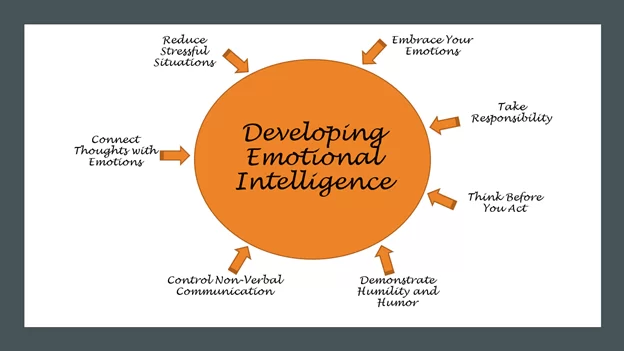
Emotional Intelligence (EI) is the ability to sense, understand, and effectively personal emotions and the emotions of those around you to get the best of human energy, information, trust, creativity, and influence. EI can deliver the following benefits: Embrace your emotions Take responsibility Think before you act Demonstrate humility and humor Control non-verbal communication Connect thoughts with emotions Reduce stressful situations EI is useful for career success, helping leaders and their staffs build a collaborative culture, emphasize everyone’s strengths, and work to mitigate weaknesses. EI is a method that can create strong bonds in teams by sharing technical expertise and creating solid recommendations for action. There are key components to EI in the workplace: self-awareness, self-regulation, social awareness or skill, empathy, and motivation. Self-awareness is the ability to know your emotions, strengths, weaknesses, and motivators and how they affect others. Self-regulation is the ability to manage personal emotional state and to think before acting. Social awareness or skill refers to proficiency in managing relationships, finding common ground, and building rapport. Empathy is about understanding and appreciate other people’s emotions, strengths, weaknesses, and motivators and use the knowledge to guide your behavior. Motivation is the passion and persistence that guides your efforts in reaching team goals. Two theories are helpful for those who embrace EI. Sensemaking Theory is a collaborative process that creates shared awareness and understanding out of different individuals’ perspectives and varied interests. Communication Accommodation Theory addresses adjusting verbal and nonverbal interactions to emphasize or minimize differences between participants. These interactions use language, context, identity, and intergroup and interpersonal factors to find common ground. There are many benefits to developing EI in the workplace beyond those listed here. I look forward to continuing the discovery.

Right Fit Leading: EI in the Workplace Read More »

beach scene silhouette 20 small

Right Fit Leading: Take Care of You

My simple plan for the week might be just what you need. va·ca·tion – /vāˈkāSH(ə)n,vəˈkāSH(ə)n/: an extended period of leisure and recreation. re·lax·a·tion – /rēˌlakˈseiSH(ə)n/: the state of being free from tension and anxiety. re·ju·ve·nate – /rəˈjo͞ovəˌnāt/: give new energy or vigor to; revitalize. in·ac·tiv·i·ty – /inakˈtivədē/: the state of being inactive; idleness.

Right Fit Leading: Take Care of You Read More »

freepik img1 use the same sames uniform black corporate su 61729

Right Fit Leading: Diversity, Equity, and Inclusion Book Project

I am working with a publisher on a potential book project covering diversity, equity, and inclusion. The intent is to publish an edited book with experts across a multitude of fields/industries who can weigh in on these topics. If you are interested in getting published as a contributing author, please reach out to me. You would need to write a chapter of about 8,000 to 10,000 words covering diversity, equity, and/or inclusion. Here are some thoughts that I am already considering for this project. Training as an approach to addressing bias in the workplace Leadership issues in diversity, equity, and inclusion: the multifaceted expressions of diversity, work relationships in diversity and inclusion, and diversity and inclusion at the organizational apex Basic requirements of a diversity plan A study of the lead diversity official in various organizations These are not the only areas that would be appropriate for this project. There is no fee to be published and no royalties will be paid, but I can assure you that your work would touch people across the globe if you decide to join the project. Thanks for listening. CONTACT: Dr. Michael A. Brown Sr, PhD, drbrown.rfc.llc@gmail.com.

Right Fit Leading: Diversity, Equity, and Inclusion Book Project Read More »

basic right fit leading logo (2) 1

Right Fit Leading: Telework Data

I would like to share some interesting discoveries from my telework research. 32.2% of hiring managers reporting about telework results listed an increase in productivity as opposed to only 22.5% who reported a decrease. Upwork Telework Survey (2020) Organizational support for teleworking ranged from “moderate” to “a great deal” for 115 of 133 respondents: 50% for “a great deal,” 20% for “a lot,” and 17% for “a moderate amount.” Brown & Siegfeldt Survey (2021) 23% of workers would stay remote if given the option. Gallup Panel (2021) 44% of workers prefer to continue working remotely. Gallup Panel Gallup Panel (2021)

Right Fit Leading: Telework Data Read More »

img 1

Right Fit Leading: Engagement is the Key

A few days ago, I had the opportunity to comment on an article about taking a leader assessment. This was an article titled “How to Spot an Incompetent Leader.” It focused in part on the importance of a leader taking a personal assessment to determine their effectiveness. This was an engagement article, and my initial comments were about combining a personal assessment with an assessment by those you lead. It’s important to find out what they want, what they like, what makes them tick, and incorporate that into the way you lead them. Sometimes you can\’t find a fit, but that too is a growth opportunity. I have a running joke with someone who worked for me before. I always say, “I get you,” to let that person know that I’m listening and I’m trying to maintain our shared understanding. Engaging your team members and working to include their desires as part of your organizational goal, where possible, can bring success. This focus can provide great benefits in terms of enriched employees who are loyal and who want to stay with the organization.

Right Fit Leading: Engagement is the Key Read More »

image

Right Fit Leading: More LMX Theory

I continue to talk with leaders about LMX Theory and the benefits that can be gained through its use. Leaders can find continued success through great relationships based on understanding the desires of their members. The theory focuses on freedom for in-group members who tend to be more talented or high performers, and close supervision of out-group members who need development. Whether the focus is on the in-group or the out-group, the leader develops trustworthiness, improves performance, and exhibits and commands accountability leading to strong relationships throughout the team. The necessary relationships are created through regular communication that allows the leader to understand who their members are on and off the job. I remember I had a great supervisor who started each day with “What brings you to work today?” This really demonstrated that he was interested in what mattered to me. This kind of communication creates shared understanding that is so valuable in effective organizations. If these thoughts could help your organization, please share the details.

Right Fit Leading: More LMX Theory Read More »

3d wristbands small

3D COACHING: “I Got You Coach!”

This is what one of my normally quiet players said to me tonight at our flag football game. Let me explain. “T” is a young man who has been a bit reserved both in his ability and his communication. He has always been a good team player, but he did not stand out in the crowd. Then came tonight. We were short-handed and “T” had to play offense and defense for every play of the game. This was greatly increased playing time for him. He became a star with touchdowns and interceptions. When I yelled congratulations across the field while he was on defense, he said, “I got you coach!” I was so glad to see him find his time to shine! This is why I coach!

3D COACHING: “I Got You Coach!” Read More »

3 small

Right Fit Leading: COVID and Telework, Conclusion

In Part 5, information about leadership development showed ways to determine and/or strengthening leadership style. A trusting connection with clear roles and responsibilities can assist with maintaining a quality work environment. My research addresses understanding of and solutions to teleworking, trustworthiness, and performance issues. Overall, it suggests using a strategic approach that encourages participation and that is required to achieve, understand, and build buy-in for teleworking. I recommend an organizationally sanctioned program that uses leader-manager exchange (LMX) theory to address the factors that contribute to motivating the target audience, the employee. A culture of self-motivation is necessary to empower employees, but there must also be a culture of enforcement when needed. Finally, buy-in at all levels of the organization is crucial to the success of any telework program. My work is focused on refining a strategic approach using important elements: how the organization develops its leaders, motivates employees, and increases productivity; how organizations use EI principles, managing radical change, and learning from available research. These factors can be used to deliver outstanding results. NOTES: I offer this series to help leaders and members reinforce what we know, discover what we do not know, and identify what we should ask questions about. The results are intended to assist everyone to deal with positive and negative aspects of telework. This is part of my educational journey that I hope has provided you with some valuable information.

Right Fit Leading: COVID and Telework, Conclusion Read More »

3 small

Right Fit Leading: COVID and Telework, Part 5

In Part 4, we highlighted performance the need to evaluate key requirements of its value in everyday conversation. We discussed the challenge of using performance to lead to the mitigation strategies and shared understanding that are vital to improving performance. Now, let’s turn to leadership development, which is important to determining and/or strengthening leadership style. Development continues when there is a trusting connection, when there are clear roles and responsibilities, and when a quality environment is maintained. Leaders must engage with their staffs and all parties need to see this engagement the same way to be effective. Recent research in this area revealed, in one case, that there can be a disconnect when employees, CEOs, and human resources professionals are asked the same questions about how people view their organization. One study showed that top-level leaders were overly optimistic about the frequency with which their employees were being recognized for their contributions. Human resources professionals, however, were pessimistic about frequent recognition, and employees seemed to be divided about how often it happened. Team qualities are listed in countless book and articles on leadership, management, and self-improvement. A leader’s focus should be on engagement, the setting of leader and manager roles, and on developing members. NOTES: I offer this series to help leaders and members reinforce what we know, discover what we do not know, and identify what we should ask questions about. The results are intended to assist everyone to deal with positive and negative aspects of telework. This series is my educational journey that I hope is valuable to you.

Right Fit Leading: COVID and Telework, Part 5 Read More »

3 small

Right Fit Leading: COVID and Telework, Part 4

In Part 3, we examined trustworthiness and how reliability comes from the quality of a person that drives desired behaviors like being respectful, honest, consistent, positive, and selfless. Part 3 offered suggestions for managers. Now let us take a look at performance. It appears that examinations of contemporary literature has primarily been focused on teleworking and non-teleworking employees. When we change that focus to leaders and leadership, we must evaluate key requirements of the value of performance in the conversation. This will lead to mitigation strategies and shared understanding that are vital to improving performance. This kind of evaluation demonstrates how leaders can help members (remember LMX theory) and let us understand how to take advantage of the benefits of teleworking. My research is keenly focused on, among other things, situations where leaders may be reluctant to use telework. One goal of my research is to understand the reasons for that reluctance and to begin the discussion about ways to improve acceptance of telework. NOTES: I offer this series to help leaders and members reinforce what we know, discover what we do not know, and identify what we should ask questions about. The results are intended to assist everyone to deal with positive and negative aspects of telework. This series is my educational journey that I hope is valuable to you.

Right Fit Leading: COVID and Telework, Part 4 Read More »

0