Blog

magnifying glass guy

Seeking Journal Reviewers

In addition to continuing the research for my latest IGI Global book on telework, I am seeking reviewers for the International Journal of Responsible Leadership and Ethical Decision Making (IJRLEDM). I am the interim editor-in-chief. IJRLEDM focuses on the role of science to help improve leadership within business and to include traditional and emerging future leadership roles. It also emphasizes responsibilities, cognition, leadership decision-making, ethics, and research methods supporting qualitative and quantitative study of these areas of life, business, and academics. Ad hoc reviewers should be able to review a minimum of 2 or 3 articles per year. If you are interested in joining this effort as an ad hoc reviewer, please apply at

Seeking Journal Reviewers Read More »

citizen small

Book Excerpt: Predictors of social networking

Predictors: I am sharing excerpts from some of my works. You can purchase relevant chapters by selecting the link “Access This Chapter” at the bottom. Chapter 8, Predictors of Social Networking and Individual Performance, Michael A. Brown (Old Dominion University, USA) and Mohamad Alkadry (Florida International University, USA) Book Excerpt, Chapter 8, Page 129 Public organizations that can successfully predict participation and understand the value propositions that drive performance can be very effective in social networking, which is a process and practice by which people and organizations are drawn together by family, work, or hobby to interact via websites. This chapter examines the relationship between social networking and individual performance. It also suggests a social networking participation model that takes advantage of innovation adoption and other important theories to help public organizations understand acceptance or rejection of participation. In a recent study, responses from 191 public administrators were analyzed using structural equation modeling (SEM) to focus on the relationship between participation and five constructs: perceived usefulness, perceived ease of use, perceived improvement potential (PIP), intra-organizational trust, and type of use. The study demonstrates favorable model fit statistics that support positive correlations between the latent variables examined and the dependent variable, participation. The results demonstrate the potential of the survey instrument to serve as an adoption and participation methodology that can provide public organizations with knowledge that predicts and promotes social networking activities as they relate to perceived performance improvement. This approach arms organizations and leaders with a new lens with which to focus on the value proposition regarding perceived improvement potential based on social networking participation. Access To This Chapter! You can get access to all of my works here.

Book Excerpt: Predictors of social networking Read More »

citizen small

Right Fit Leading: CLUE Leadership Skills

CLUE is a helpful formula for developing or refining leadership skills. Connect. Conduct the rest of the engagement in search of a win-win outcome. If that is not possible, strive for a shared understanding where all parties know the engagement’s views and commitments, proposed goals or outcomes, and next steps. Listen. Make sure you hear what everyone is saying. Good listening is like good research. The researcher is after truth regardless of the reason for the effort. Understand. Listen to understand, not to reply for the best results. Then do what good communication requires by analyzing what you have heard and compare it to what you already know. If your approach needs to change based on that understanding, you might want to schedule a session at another time. But make sure to schedule the session. Engage. Ensure that the conversation pays attention to the views and commitments of all parties with an equitable focus on these issues. Get started on connecting with people, keep connecting with people, and find ways to measure your connections with people.

Right Fit Leading: CLUE Leadership Skills Read More »

author 4

Right Fit Leading: “The Talk”

Companies and their leaders get anxious when deciding on having “the talk” with employees. “The talk” can be positive or negative and it goes beyond whether people are onsite, remote, or hybrid workers. Let us look at leading and managing employees with a focus that is as much on the engagement as it is on the issue. No matter where people work, leaders must employ open and honest communication at every opportunity. I am seeing many wonderful approaches to leadership, but leaders must be agile in the way they communicate. There are 4 ways leaders can ensure successful communications. Engage. Ensure that the conversation pays attention to the views and commitments of all parties with an equitable focus on these issues. Listen. Make sure you hear what everyone is saying. Good listening is like good research. The researcher is after truth regardless of the reason for the effort. Understand. Listen to understand, not to reply for the best results. Then do what good communication requires by analyzing what you have heard and compare it to what you already know. If your approach needs to change based on that understanding, you might want to schedule a session at another time. But make sure to schedule the session. Connect. Conduct the rest of the engagement in search of a win-win outcome. If that is not possible, strive for a shared understanding where all parties know the engagement’s views and commitments, proposed goals or outcomes, and next steps. I hope this engage-listen-understand-connect roadmap for “the talk” is helpful for you. Let me know if you would like to discuss further.

Right Fit Leading: “The Talk” Read More »

service 3 1

Right Fit Leading: Consider Hiring Culture

Organizations need to consider their hiring culture to make sure they are kind to job seekers. This may not be someone you eventually hire, but it is someone who has a voice and who can speak volumes about your organization. Why am I writing this? A person I am mentoring recently went for an in-person interview and he was very excited about the prospects. The company told him they were filling more than one position. When he arrived for the interview, he was one of some 40 people undergoing a group interview for 4 positions. Then the organization announced that there would be a chance for people to stay for in-person interviews in the afternoon. My mentee said many people left at that point. In addition to telling job hunters the pay levels of the positions they are seeking; employers should practice full disclosure in advance about how the interview will be conducted. They should also give the person a good sense of where they are in the interview process. I am not a life coach; but I am skilled in leader and business development. The best advice I give to those I mentor about job hunting is to understand that if it is not in writing, it does not exist. That extends to how, when, and where the interview will be conducted. Have you had similar experiences?

Right Fit Leading: Consider Hiring Culture Read More »

diapositiva1 small

Info Series: Training the Leader

My conversations with leaders often focus on training. Lately, they indicate a need to change the focus of training the leader from the traditional leader-centric philosophy to one of engagement, interaction, and collaboration. This creates an atmosphere where leaders and those they lead have equal opportunities to affect the leader-follower relationship. Over the last 2 years, I have taken a closer look at leadership training for various education and business projects. The analysis suggests that a lot of training courses, regardless of type (i.e., prescriptive, elective, etc.) is rooted in an authoritative approach. This approach shows the predominance of leadership styles expected and/or taught are dictated and driven by the leader/supervisor.  Likewise, these styles are steeped in the expectation that the leader/supervisor can define his/her level of feedback, with little to no emotional investment involved with subordinates. In addition, this approach suggests that the success of the leader/supervisor-follower relationship is the lone responsibility of the leader/supervisor.  I say this thinking has some flaws, and this style of training misses the mark. The flaws can limit maximizing the interactive engagement in an effective leader/supervisor-follower relationship. Instead, what is perpetuated is a “disengaged” relationship in the work environment, a lack of understanding between leader/supervisor-follower teams, and poor collaboration toward meeting a desired end state. My continuing research, led me to \”Training the Leader Trajectory: Focusing on People, Empathy, and Emotional Intelligence (EI) in the Workplace.” Achieve an equitable work culture where all members, regardless of their role, have equal participation and decision-making ability in the operations and culture of the organization. This ensures that emotions and empathy are inherent to the leadership style. Then, feedback is encouraged and expected of all parties, all parties can become emotionally invested in their efforts, and everyone strives toward greater collaboration and teamwork. I am excited about how this is developing. Please let me know if you would like to know more about my approach to leader training.

Info Series: Training the Leader Read More »

right fit leading info series small

Right Fit Leading: Motivation

Just sharing some motivation quotes that are in my collection. I have used these and others before and during games with the teams I have coached. You have to expect things of yourself before you can do them. Michael Jordan Do not let what you cannot do interfere with what you can do. John Wooden The minute you start talking about what you are going to do if you lose, you have lost. George Shultz You can become a winner only if you are willing to walk over the edge. Damon Runyon What is your favorite motivational quote?

Right Fit Leading: Motivation Read More »

right fit leading info series small (1)

Examining Remote Work Pros and Cons

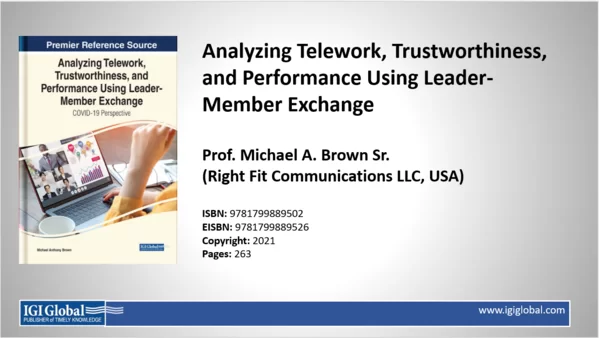
While I was doing research on remote work for my latest book, Analyzing Telework, Trustworthiness, and Performance Using Leader-Member Exchange: COVID-19 Perspective, I found consistent themes in terms of reluctance to allow telework/remote work. I characterized the research into 13 reasons that may be given about the perils of telework/remote work. Let me provide some detail on three examples that relate across some of the reasons in this list. EXAMPLE 1: One manager told me, “I need to have impromptu meetings to work out problems or to address emerging issues.” These were my questions. EXAMPLE 2: One leader told me, “I need face-to-face connection with workers who need structure or close supervision.” These were my questions. EXAMPLE 3: The director in one organization told me she was just more comfortable with employees onsite and that there were rewards or incentives available, making it unnecessary to offer remote work as an incentive. I asked her to think about an employee she could not do without. Then I asked questions. I cannot answer these questions for anyone. There are many variables and situations that must be considered to determine one of four paths in this area: Leaders should be at least open to considering the use of some form remote work. This helps prepare organizations to successfully transition to distributed operations during times of emergency and, just as important, enables ways to enrich the work environment for the workforce. Considering the use of remote work or some hybrid approach opens the door to win-win situations for both organization and employee. We never know what will happen tomorrow but, as COVID taught us, having a way for people to take care of their loved ones while still working is important. This is important as demonstrated in a survey that reported that 37% of employees would leave their current job in favor of one that allowed them to choose their work location at least part of the time (Gallup, 2017). I recommend thinking of telework as an investment in people to give them flexibility in the interest of improving work-life balance. Using a hybrid approach can be effective if you ensure two-way communication with feedback to create and nurture trust. It should be combined with culture and operations supportive of both on site and remote workers promoting equal treatment in an effort to achieve buy-in. REFERENCE: Gallup, I. (2017). State of the American workplace. Pobrane z http://www. gallup. com/reports/199961/state-american-workplace-report-2017. aspx.

Examining Remote Work Pros and Cons Read More »

0