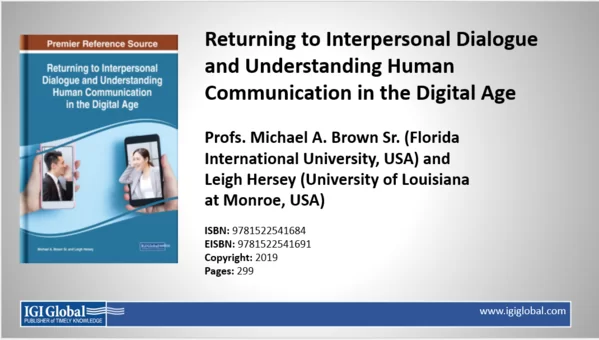
Interpersonal Dialogue

about (1)

RFL: Interactive Communications

Recently, I have been talking with colleagues about a book chapter I wrote on interactive communications, which combines the best of digital and face-to-face communication. This is about hybrid approaches to communication and what I find out in my research. First, digital communication is the best method. Second, these communications improve when combined with face-to-face interactions. Hybrid communicating involves asking detailed questions and verifying answers in the digital space. If that does not work, face-to-face interactions provides verbal and visual cues. This allows all parties to the communication to adjust based on real-time inputs. My research in this area demonstrates that interactive communication skills are one of many kinds of tools that can assist with leader and team development. The book in question is Innovative Perspectives on Interactive Communication Systems and Technologies by Muhammad Sarfraz, and my contribution is chapter 11. I look forward to continuing discoveries in this area. Note: RFL is Right Fit Leading, our approach to the leader and member development journey.

RFL: Interactive Communications Read More »

returning small

Book Excerpt: About Emotional Intelligence and empathy

This excerpt offers good information on emotional intelligence (EI) and empathy. You can purchase relevant chapters by selecting the link “Access This Chapter” at the bottom. Book Excerpt, Chapter 10, Page 204 The rise of EI and the continuing growth of online interactions work together to demonstrate the importance of participatory decision making as a motivational technique. However, participation in decisions requires that the leader act in a prosocial manner, focusing on outcomes that are beneficial to more than just the leader. A prosocial attitude leads to creation of buy-in through shared value and good management of emotions, requiring skill in both EI and empathetic approaches. EI is about connecting with one\’s own emotions and those of others to enable effective leadership communication. Empathy is the ability to understand someone else\’s emotions, feel them as if they were yours, and even to take some action in support or mitigation of those feelings. The lack of feedback or agreements on shared value in online interactions are highlighted when people are forced into face-to-face interactions and are subsequently unable to find these important communication tools. This chapter offers a new approach to leadership communication. Access This Chapter!

Book Excerpt: About Emotional Intelligence and empathy Read More »

Right Fit Leading: Happy New Year!

Wishing you and yours the best year ever! No New Year\’s Resolution for me; just staying the course. Focusing on Emotional Intelligence (EI) to create stability in leadership and organizational development. That means three things: – Analyzing situations without bias at the outset. – Creating momentum to achieve goals without allowing yourself to be fatigued. – Taking action without being discouraged with life\’s bumps and bruises. Happy New Year! I hope to talk with you and your organization!

Right Fit Leading: Happy New Year! Read More »

Right Fit Leading: Make Listening About Them, Not You!

What you do while you are listening is just as important as the fact that you listen.  I have seen a few examples of people trying to make a point and the listener cuts the person off with the “what happened to me story.”  This is often the wrong approach.   Make listening about Them, not about You.  Leaders are often taught about listening but not about hearing.  Listen to understand what the person is really saying and what it means to Them.  Strive for a comfortable exchange where you ask for clarification and feedback before you inject your own story that “matches” the person’s situation. A good way to make sure you are successful is avoid multitasking, put down your phone, make eye contact, and clarify the information you are hearing.  Many times there will be an opening to inject your personal experience.  But if the opportunity doesn’t present itself, let it go.   Make listening about Them, not about you.   What is your listening style?

Right Fit Leading: Make Listening About Them, Not You! Read More »

2011 09 23 07.44.34 (1)

Right Fit Leading: Motivation is Choice, Effort, Persistence

Choice refers to either getting people to select an action on their own or making a case for why they should take the path the leader or the group recommends.  Effort is about how much energy a person gives to an initiative.  Persistence is when people keep trying even if they don’t believe their effort and energy is enough.  This is ultimately about faith.  A motivational leader can inspire the kind of adrenaline in a person that allows them to move past their hesitations, find energy where there is none, and believe even if they don’t have all the reasons for that belief.   Leader communications should reinforce these concepts to motivate people.   Get Published: If you have some great ideas about leadership communication and its importance, check out the call for chapters for a new book, Returning to Interpersonal Dialogue and Understanding Human Communication in the Digital Age.  It\’s not too late to submit a chapter, or get more information, here: Returning to Interpersonal Dialogue.

Right Fit Leading: Motivation is Choice, Effort, Persistence Read More »

Submission Deadline Extended: Interpersonal Dialogue Call for Chapter Proposals

We have extended the deadline to submit chapters to May 1.  You still have a chance to join the project! Returning to Interpersonal Dialogue and Understanding Human Communication in the Digital Age A book edited by Michael A. Brown Sr, PhD, Florida International University, and Leigh Hersey, Ph.D., University of Louisiana at Monroe   Introduction Human communication is struggling in what is a global crisis.  Society no longer fosters face-to-face interactions.  Compounded by the influence of the digital world, digitally-driven interactions in a multi-generation society have resulted in personal interactions that are fraught with limited feedback, erroneous and incomplete information leading to misunderstandings, even confrontations.  Digital collaborations are abundant, but can be problematic as an incomplete solution to the human need for comprehensive communication.  The 5,000 digital messages the average American receives daily lack full-process interactions from sender to receiver to feedback (see note). This creates communication based on missing information, gaps in communication, misinterpretation of language and other barriers.  Human communication distinguishes face-to-face communication as a priority over online or digital interactions.  This is not to downplay the electronic arena; just to highlight the connection between people that involves the five senses.   Objective of the Book Dr. Brown’s previous work in Solutions for High-Touch Communication in a High-Tech World (IGI Global, March 2017) sets the stage for a full examination of human communication in today’s society by comparing online and face-to-face interactions.  This book takes advantage of that foundation and develops solutions for success in academia and in business by analyzing various types of face-to-face and digital interactions in terms of comprehension and relationship-building.  The integration of techniques for all human communication gives people resources to be successful collaborators in contemporary society.  This is an approach you won’t find in any one book today.   Submission Procedure Researchers and practitioners are invited to submit on or before May 1, 2017, a chapter proposal of 1,000 to 2,000 words clearly explaining the mission and concerns of his or her proposed chapter. Submit your proposal at http://www.igi-global.com/publish/call-for-papers/call-details/2660.  

Submission Deadline Extended: Interpersonal Dialogue Call for Chapter Proposals Read More »

2010 04 17 11.19.14

Right Fit Leading: Do We Connect?

Do we connect?  People post, but do they read?  People talk, but do they listen?  People hear, but do they understand?   Let\’s find the answers together.  Add your voice, and your research, by submitting a chapter to my upcoming book on interpersonal dialogue.  Submit at http://www.igi-global.com/publish/call-for-papers/call-details/2660.

Right Fit Leading: Do We Connect? Read More »

Right Fit Leading: Leadership Ingredients Defined

  Leadership is analysis without bias, momentum without fatigue, and action without discouragement.   Analysis without Bias: Skill is important because leaders have to know what they are doing.  They analyze the way ahead and determine what is necessary.  You can determine what is necessary by yourself or with the team, but you have to make the determination.  When you analyze the situation or the task at hand, you have to begin without caring what the final answer will be, and you have to keep an open mind throughout the analysis.  If you do this without preconceived notions, especially with a group, you can find new ideas and different viewpoints that will be beneficial.   Momentum without Fatigue: Once you decide which way to go, get going.  Attack the solution with conviction and create that momentum that will propel you and the team to the project’s successful conclusion.  There will be challenges and disappointments along the way, but great leaders don’t get tired.  They keep pushing toward the decided course of action.  This is important to the relationship with the team.  Members of the team may tire, but they can feed off the leader’s energy.  If the leader truly becomes tired, it is time for a team champion to take the lead temporarily.  This will signal that the leader’s trust in the team that has been assembled.  But the leader can’t stay disconnected for long, because there is still much to do.   Action without Discouragement: Once the leader has a decision on a course of action, it’s time to move out.  Always take action to implement the decisions that have been made based on the analysis of the goal and its needs.  There will be bumps in the road, but effective leaders don’t get discouraged.  They commit to the decided course of action and move in that direction.  They show the team that all of the prior work was necessary and that the results are accurate.  If there is a problem, a course correction is always the preferred way to proceed instead of starting from scratch.  If the leader finds it necessary to start from scratch, it is important to not only explain it to the team, but to fully go back and find out where the analysis may have gone wrong.   Get Published: By the way, communication is essential for leaders.  If you have some great ideas, check out the call for chapters for a new book, Returning to Interpersonal Dialogue and Understanding Human Communication in the Digital Age.  Submit a chapter, or get more information, here: Returning to Interpersonal Dialogue.

Right Fit Leading: Leadership Ingredients Defined Read More »

Right Fit Leading: Leader Flexible Communications

    Great leaders are flexible communicators, listening and learning on the fly to adjust to each participant\’s emotion, risk, and feedback to get the most out of the interaction. Join me in exploring interpersonal dialogue by submitting a chapter for an upcoming book, Returning to Interpersonal Dialogue and Understanding Human Communication in the Digital Age.  You can get more information and submit your chapter at: Returning to Interpersonal Dialogue.

Right Fit Leading: Leader Flexible Communications Read More »

Call for Chapter Proposals: Interpersonal Dialogue and Human Communication

  CALL FOR CHAPTER PROPOSALS Returning to Interpersonal Dialogue and Understanding Human Communication in the Digital Age A book edited by Michael A. Brown Sr, PhD, Florida International University, and Leigh Nanney Hersey, Ph.D., University of Louisiana at Monroe     Introduction Human communication is struggling in what is a global crisis.  Society no longer fosters face-to-face interactions.  Compounded by the influence of the digital world, digitally-driven interactions in a multi-generation society have resulted in personal interactions that are fraught with limited feedback, erroneous and incomplete information leading to misunderstandings, even confrontations.  Digital collaborations are abundant, but can be problematic as an incomplete solution to the human need for comprehensive communication.  The 5,000 digital messages the average American receives daily lack full-process interactions from sender to receiver to feedback (see note). This creates communication based on missing information, gaps in communication, misinterpretation of language and other barriers.  Human communication distinguishes face-to-face communication as a priority over online or digital interactions.  This is not to downplay the electronic arena; just to highlight the connection between people that involves the five senses. High-touch, effective communication is about using social capital to build relationships and make information-sharing connections.  It is important to improve internal and external digital communications and to demonstrate ways to “positively affect productivity, levels of trust, and the ability to conduct bonding, bridging, and linking activities.”  High-touch activities lead to engagingly effective communication relationships with valuable feedback.  The book would address face-to-face interactions and digital collaboration, possibly in separate sections. NOTE: Sheree Johnson, New Research Sheds Light on Daily Ad Exposures, Sept. 29, 2014, https://sjinsights.net/2014/09/29/new-research-sheds-light-on-daily-ad-exposures/ .   Objective of the Book Dr. Brown’s previous work in Solutions for High-Touch Communication in a High-Tech World (IGI Global, March 2017) sets the stage for a full examination of human communication in today’s society by comparing online and face-to-face interactions.  This book takes advantage of that foundation and develops solutions for success in academia and in business by analyzing various types of face-to-face and digital interactions in terms of comprehension and relationship-building.  The integration of techniques for all human communication gives people resources to be successful collaborators in contemporary society.  This is an approach you won’t find in any one book today.   Recommended topics include, but are not limited to, the following: A global communication crisis?  Real or imagined? Data Gathering Relevant to the Challenge Unmediated and Mediated Interactions Face-to-Face Interactions Digital Collaboration Integrated Communication Focus on the Non-Digital Aspects of Communication in Society Communication: Interaction, Collaboration or Both? Communication, Evaluation and Comprehension Health and Communication Choosing the Right Platform for Communicating Developing relationships – face-to-face and online Making Communication Human – full-process communication with feedback Historical development of face-to-face vs online communication New research directions in human communication Evaluating social media communication Evaluating social media trust Comparing face-to-face and online communication methods, strengths, weaknesses Interactive communication Evaluating quantity vs quality in communication Trust and communication Trust and privacy Inter-organizational communication   Submission Procedure Researchers and practitioners are invited to submit on or before April 1, 2017, a chapter proposal of 1,000 to 2,000 words clearly explaining the mission and concerns of his or her proposed chapter. Submit your proposal at http://www.igi-global.com/publish/call-for-papers/call-details/2660. Authors will be notified by June 1, 2017 about the status of their proposals and sent chapter guidelines. Full chapters are expected to be submitted by August 1, 2017, and all interested authors must consult the guidelines for manuscript submissions at http://www.igi-global.com/publish/contributor-resources/before-you-write/ prior to submission. All submitted chapters will be reviewed on a double-blind review basis. Contributors may also be requested to serve as reviewers for this project. Note: There are no submission or acceptance fees for manuscripts submitted to this book publication, Returning to Interpersonal Dialogue and Understanding Human Communication in the Digital Age. All manuscripts are accepted based on a double-blind peer review editorial process. All proposals should be submitted through the E-Editorial DiscoveryTM online submission manager. Publisher This book is scheduled to be published by IGI Global (formerly Idea Group Inc.), an international academic publisher of the “Information Science Reference” (formerly Idea Group Reference), “Medical Information Science Reference,” “Business Science Reference,” and “Engineering Science Reference” imprints. IGI Global specializes in publishing reference books, scholarly journals, and electronic databases featuring academic research on a variety of innovative topic areas including, but not limited to, education, social science, medicine and healthcare, business and management, information science and technology, engineering, public administration, library and information science, media and communication studies, and environmental science. For additional information regarding the publisher, please visit www.igi-global.com. This publication is anticipated to be released in 2017. Important Dates April 1, 2017: Proposal Submission Deadline June 1, 2017: Notification of Acceptance August 1, 2017: Full Chapter Submission September 30, 2017: Review Results Returned November 15, 2017: Final Acceptance Notification November 30, 2017: Final Chapter Submission Inquiries can be forwarded to Michael A. Brown Sr, PhD Florida International University dr.michael.brown76@gmail.com (757) 876-6589 Leigh Nanney Hersey, PhD University of Louisiana at Monroe Hersey@ulm.edu (318) 342-1332  

Call for Chapter Proposals: Interpersonal Dialogue and Human Communication Read More »

0