
Leadership

developing ei

RFL: Good Emotional Intelligence Achieves Win-Win Situations

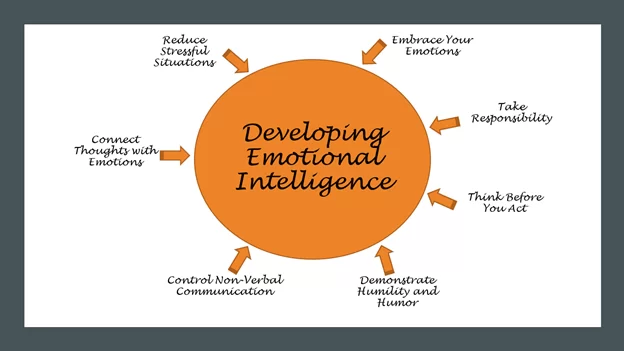
Being good at Emotional Intelligence (EI) can help you achieve win-win situations. For me, the bottom line of EI is to understand your emotions, and the way you do things based on those emotions, and to understand the emotions of people around you and the way they do things based on those emotions. Then you try to find a balance, a collaboration, or a win-win situation. Once you start to understand those emotions, you can think about them and take some action. After a recent speech in Chicago, Illinois, someone asked me why I am so fond of EI. My answer was that EI forces me to assess myself in relation to those around me. It drives me to seek balance or to create collaboration. Once you start to understand those emotions, you can think about them and take some action. Leading or following using EI principles means that you accept the need to engage, to communicate, and to pursue shared understanding. EI can be really simple if you can understand yourself and how you react. It can help you if you understand others with whom you interact, and then examine how they react to their emotions. Then you can try to find a middle ground. It might not be middle ground; it might be 60-40 in someone’s favor to get it to work. But you must remember that the only way that you’re going to understand their emotions and the way they react is to engage.   Note: RFL is Right Fit Leading, our approach to the leader and member development journey.

RFL: Good Emotional Intelligence Achieves Win-Win Situations Read More »

personal 1264695 1920

Improving Your emotional Intelligence

I had a great day today presenting Improving Your Emotional Intelligence: Creating a Win-Win Collaborative Culture. I gave the speech to a client conference in Chicago with more than 100 attendees. What was the highlight of my interactive presentation? The importance of remembering that a win-win collaborative culture leads to shared understanding. There are many things you can talk about when building or improving your culture. You can discuss emotional intelligence, empathy, engagement, organizational development, or even about training. My main point is that the win-win and shared understanding aspects are what make my presentation a little different than others.

Improving Your emotional Intelligence Read More »

a3 poster 1296448 340 e1504527875599

RFL: Collaborative Leadership

Collaborative leadership is a non-traditional way to address organizational development. By training leaders and those they lead together, this approach allows skill development in philosophy, inspiration, and motivation. This approach focuses on collaborative ways to create effective relationships and effective teams. Using emotional intelligence (EI) and empathy, leaders get in touch with those they lead. They look to master their own emotions and those of others. This approach relies on effective engagement, and it fosters the pursuit of win-win situations that create shared understanding. In addition, organizational relationships improve as trust develops, and as cultural developments are observed. NOTE: The Right Fit Leading (RFL) Process addresses the need to change the focus of training from the traditional leader-centric philosophy to one of engagement, interaction, and collaboration. This creates an atmosphere where leaders and those they lead have equal opportunities to affect the leader-follower relationship that is required in effective teams. The RFL Process promotes the creation of effective teams because it is based on emotional intelligence and empathy for all members, regardless of their position or level of responsibility. The RFL Process addresses a consistent philosophy of how we lead and follow. It suggests that we must inspire ourselves and others. It also demonstrates the need to motivate ourselves and others to take on challenges that we might not attempt otherwise. We use emotional intelligence (EI) and empathy, engagement, LMX Theory, and knowledge about the meaning of trust and how it is developed and nurtured. At this point, development can turn its focus to what is needed for each leader and member. We use the principle of engaged interaction to help leader and team development subjects arrive at a shared understanding.

RFL: Collaborative Leadership Read More »

freepik img1 use the same sames uniform black corporate su 61729

RFL: Leadership is an Action

Leadership is not about what you say, it is about what you do. The key to leadership is whether what you do resonates with those you lead. If you are emotionally intelligent, empathic, engaging, and collaborative, it should be evident in your actions. This is just as important as what you say. If you listen intently and adjust to the feedback you’re receiving, it will influence and motivate actions that matter. What I’m talking about is sharing your skills and your passion with those you lead. Seek out win-win relationships that strive for shared understanding and, when you don’t have it, stop and work on it. Leadership is a state of mind that you should share with your team. The team is watching you, and the team will follow you if your actions are worthy of it. More important, they will be your partners in achieving mission accomplishment. NOTE: The Right Fit Leading (RFL) Process addresses the need to change the focus of training from the traditional leader-centric philosophy to one of engagement, interaction, and collaboration. This creates an atmosphere where leaders and those they lead have equal opportunities to affect the leader-follower relationship that is required in effective teams. The RFL Process promotes the creation of effective teams because it is based on emotional intelligence and empathy for all members, regardless of their position or level of responsibility. The RFL Process addresses a consistent philosophy of how we lead and follow. It suggests that we must inspire ourselves and others. It also demonstrates the need to motivate ourselves and others to take on challenges that we might not attempt otherwise. We use emotional intelligence (EI) and empathy, engagement, LMX Theory, and knowledge about the meaning of trust and how it is developed and nurtured. At this point, development can turn its focus to what is needed for each leader and member. We use the principle of engaged interaction to help leader and team development subjects arrive at a shared understanding.

RFL: Leadership is an Action Read More »

ei trust lmx small

RFL: Building Trust

Trust is important in every organization and every leader should be actively building trust. This is done through continuous engagement in a collaborative relationship. The relationship allows trust to develop. Leaders can nurture that development by instilling in every member an understanding of their value to the group. Building trust in this way can contribute to achieving organizational goals and to encouraging cooperation from all members. Collaboration supports trusting relationships when it creates an environment that allows people to share work. It allows participants to understand each person’s situation and it creates open and honest group communications. Leaders can be effective when they engage at all levels of the organization. Engagement helps employees see their value through a win-win collaboration that creates shared understanding. Trust is also stronger when leaders and members share feedback, especially when someone misses the interaction for whatever reason.

RFL: Building Trust Read More »

leader member development overview wheel small

RFL: Develop Leadership

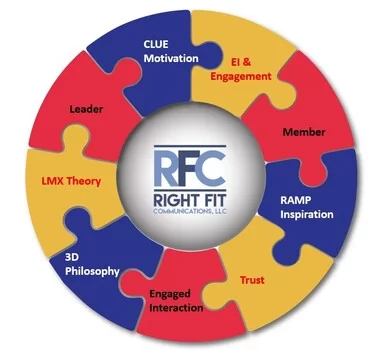
One cannot develop leadership by only focusing on the leader and which of their skills need development or improvement. Using Leader-Member Exchange (LMX) Theory, you can understand that leadership development is best done by developing and/or improving the skills of both the leader and those they lead. This approach leads to shared understanding that allows effective team building. The Right Fit Leading (RFL) Process addresses this challenge. RFL characterizes leader and team development in terms of three key components. Good leadership and followership are tied to each other, whether they are taught and trained that way or not. Current research supports the belief that good leadership is about philosophy, inspiration, and motivation. The RFL Process is based on emotional intelligence and empathy for all members of any team, regardless of their position or level of responsibility. The RFL Process addresses a consistent philosophy of how we lead and follow. It suggests that we must inspire ourselves and others. It also demonstrates the need to motivate ourselves and others to take on challenges that we might not attempt otherwise. So, the RFL Process is instrumental in leader and team development. It starts with the three major parts my vision: 3D Philosophy, RAMP Inspiration, and CLUE Motivation. The next step is in understanding the tools that are most helpful. For that, we use emotional intelligence (EI) and engagement, LMX, and knowledge about the meaning of trust and how it is developed and nurtured. At this point, development can turn its focus to what is needed for each leader and member. We use the principle of engaged interaction to help development subjects arrive at a shared understanding. This is a formula for organizational and leadership development success. Please let me know if you want like more information on the RFL Process.

RFL: Develop Leadership Read More »

about (1)

RFL: Interactive Communications

Recently, I have been talking with colleagues about a book chapter I wrote on interactive communications, which combines the best of digital and face-to-face communication. This is about hybrid approaches to communication and what I find out in my research. First, digital communication is the best method. Second, these communications improve when combined with face-to-face interactions. Hybrid communicating involves asking detailed questions and verifying answers in the digital space. If that does not work, face-to-face interactions provides verbal and visual cues. This allows all parties to the communication to adjust based on real-time inputs. My research in this area demonstrates that interactive communication skills are one of many kinds of tools that can assist with leader and team development. The book in question is Innovative Perspectives on Interactive Communication Systems and Technologies by Muhammad Sarfraz, and my contribution is chapter 11. I look forward to continuing discoveries in this area. Note: RFL is Right Fit Leading, our approach to the leader and member development journey.

RFL: Interactive Communications Read More »

imageedit 6 6322409839

Right Fit Leading: Trustworthiness

Trustworthiness is the quality of a person, or a thing, that inspires reliability. When trustworthiness exists, it is shown through several qualities. These include being respectful, honest, consistent, positive, and selfless. Leaders who can admit mistakes, acknowledge weakness, applaud strength, and help each other should do well. Also, those who can promote those qualities in the workforce will be highly capable of building trust. Mutual trust is important, and everyone has a lot at stake with trust issues because of the inherent risks. Those risks are about putting one’s faith or a pending decision in the hands of someone if a sense of confidence has not been developed. Once confidence in others grows, emotions can be shared, and real issues can be addressed. I look forward to future discussions on trustworthiness. Graphic by macrovector on Freepik

Right Fit Leading: Trustworthiness Read More »

leader member development overview wheel small (1)

The Right Fit Leading Process

The Right Fit Leading Process is not new. What is new is the way that new research in the areas of emotional intelligence, empathy, trust, team development. That means a host of other leadership considerations have come together for me. It is now clearer than ever that the way to build successful organizations is to develop leaders and members together and let them engage to find shared understanding. It is no longer enough to develop leaders. We must build teams where leaders and those they lead partner in developing philosophy, inspiration, and motivation. The Right Fit Leading Process has as its foundation emotional intelligence and empathy. These are collaboratively developed for the leader and the member or follower. We use engaged interaction to develop leaders and members at the same time through collaborative training methods. The basics of our focus always include EI and engagement, LMX Theory, and trust. The process focuses on a consistent philosophy of the way we lead and follow. The process suggests that all members of the organization have a responsibility to inspire themselves and others. That means the organization needs work relationships where people at all levels motivate themselves and others to take on challenges that they might not attempt otherwise. The process can help leaders and those they lead in diverse types of organizations and industries. The process can develop teams, leaders, and members, promoting trust, engagement, and other benefits that can lead to success and growth. Please contact me if you want to know more about the Right Fit Leading Process.   NOTE: Graphic courtesy of Hafsa Akhter, SA Digitech

The Right Fit Leading Process Read More »

rfl process

Right Fit Leading: Philosophy, Inspiration, and Motivation

Dr. Brown’s research and engagements support the belief that good leadership is about philosophy, inspiration, and motivation. The Right Fit Leading Process is based on emotional intelligence and empathy for the leader and the member or follower. The process focuses on a consistent philosophy of the way we lead and follow. It suggests that we must inspire ourselves and others. Finally, it recommends that we motivate ourselves and others to take on challenges that we might not attempt otherwise. The process can help leaders and those they lead in diverse types of organizations and industries. The process is complementary to trust research from some dynamic colleagues. In the coming weeks, Dr. Brown will be sharing the details of this process.

Right Fit Leading: Philosophy, Inspiration, and Motivation Read More »

0