Right Fit Leading

diapositiva1 small

Info Series: Training the Leader

My conversations with leaders often focus on training. Lately, they indicate a need to change the focus of training the leader from the traditional leader-centric philosophy to one of engagement, interaction, and collaboration. This creates an atmosphere where leaders and those they lead have equal opportunities to affect the leader-follower relationship. Over the last 2 years, I have taken a closer look at leadership training for various education and business projects. The analysis suggests that a lot of training courses, regardless of type (i.e., prescriptive, elective, etc.) is rooted in an authoritative approach. This approach shows the predominance of leadership styles expected and/or taught are dictated and driven by the leader/supervisor.  Likewise, these styles are steeped in the expectation that the leader/supervisor can define his/her level of feedback, with little to no emotional investment involved with subordinates. In addition, this approach suggests that the success of the leader/supervisor-follower relationship is the lone responsibility of the leader/supervisor.  I say this thinking has some flaws, and this style of training misses the mark. The flaws can limit maximizing the interactive engagement in an effective leader/supervisor-follower relationship. Instead, what is perpetuated is a “disengaged” relationship in the work environment, a lack of understanding between leader/supervisor-follower teams, and poor collaboration toward meeting a desired end state. My continuing research, led me to \”Training the Leader Trajectory: Focusing on People, Empathy, and Emotional Intelligence (EI) in the Workplace.” Achieve an equitable work culture where all members, regardless of their role, have equal participation and decision-making ability in the operations and culture of the organization. This ensures that emotions and empathy are inherent to the leadership style. Then, feedback is encouraged and expected of all parties, all parties can become emotionally invested in their efforts, and everyone strives toward greater collaboration and teamwork. I am excited about how this is developing. Please let me know if you would like to know more about my approach to leader training.

Info Series: Training the Leader Read More »

right fit leading info series small

Right Fit Leading: Motivation

Just sharing some motivation quotes that are in my collection. I have used these and others before and during games with the teams I have coached. You have to expect things of yourself before you can do them. Michael Jordan Do not let what you cannot do interfere with what you can do. John Wooden The minute you start talking about what you are going to do if you lose, you have lost. George Shultz You can become a winner only if you are willing to walk over the edge. Damon Runyon What is your favorite motivational quote?

Right Fit Leading: Motivation Read More »

right fit leading info series small (1)

Examining Remote Work Pros and Cons

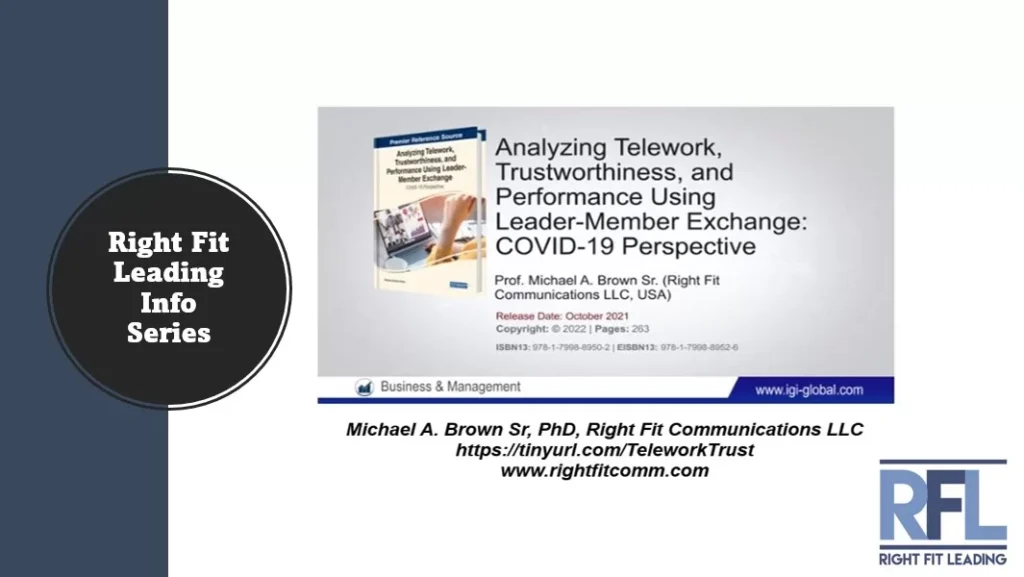
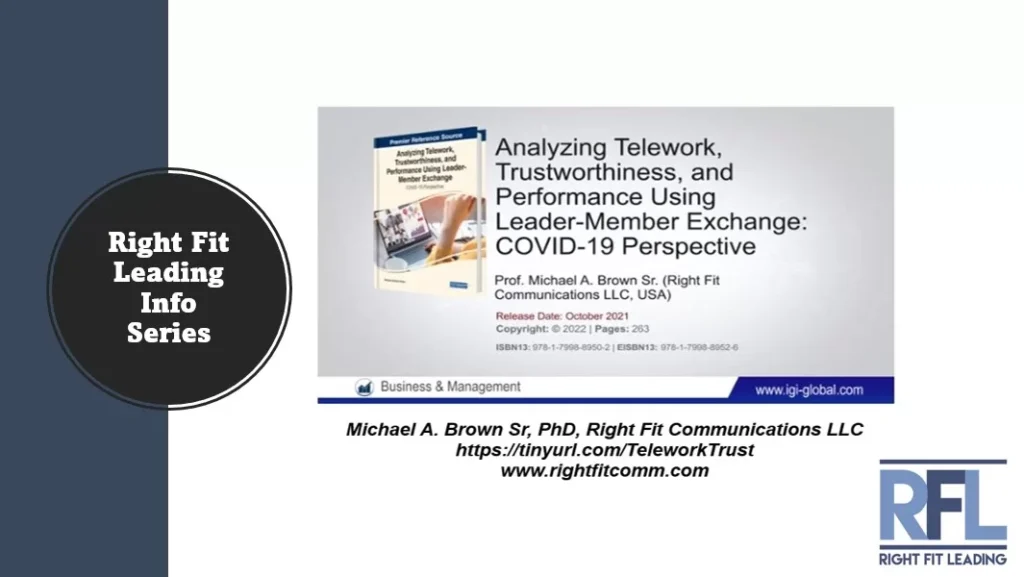
While I was doing research on remote work for my latest book, Analyzing Telework, Trustworthiness, and Performance Using Leader-Member Exchange: COVID-19 Perspective, I found consistent themes in terms of reluctance to allow telework/remote work. I characterized the research into 13 reasons that may be given about the perils of telework/remote work. Let me provide some detail on three examples that relate across some of the reasons in this list. EXAMPLE 1: One manager told me, “I need to have impromptu meetings to work out problems or to address emerging issues.” These were my questions. EXAMPLE 2: One leader told me, “I need face-to-face connection with workers who need structure or close supervision.” These were my questions. EXAMPLE 3: The director in one organization told me she was just more comfortable with employees onsite and that there were rewards or incentives available, making it unnecessary to offer remote work as an incentive. I asked her to think about an employee she could not do without. Then I asked questions. I cannot answer these questions for anyone. There are many variables and situations that must be considered to determine one of four paths in this area: Leaders should be at least open to considering the use of some form remote work. This helps prepare organizations to successfully transition to distributed operations during times of emergency and, just as important, enables ways to enrich the work environment for the workforce. Considering the use of remote work or some hybrid approach opens the door to win-win situations for both organization and employee. We never know what will happen tomorrow but, as COVID taught us, having a way for people to take care of their loved ones while still working is important. This is important as demonstrated in a survey that reported that 37% of employees would leave their current job in favor of one that allowed them to choose their work location at least part of the time (Gallup, 2017). I recommend thinking of telework as an investment in people to give them flexibility in the interest of improving work-life balance. Using a hybrid approach can be effective if you ensure two-way communication with feedback to create and nurture trust. It should be combined with culture and operations supportive of both on site and remote workers promoting equal treatment in an effort to achieve buy-in. REFERENCE: Gallup, I. (2017). State of the American workplace. Pobrane z http://www. gallup. com/reports/199961/state-american-workplace-report-2017. aspx.

Examining Remote Work Pros and Cons Read More »

right fit leading info series

Don\’t Wait For The Exit Interview

Do not wait to learn vital information about your employee during the exit interview. Instead, at least once a year after appraisal time, ask these questions. Start out by telling the employee that you may not be able to achieve what they tell you, but that you want to understand what the future looks like to THEM! Do not ask them how they like their boss or what they think of the organization. Find out what they WANT FOR THEMSELVES. This information is available today; right now. But we often wait until the exit interview to understand people’s motivation. I will soon be changing jobs with mixed feelings. The supervisor I am “leaving” always had conversations throughout the year about what I wanted to do and where I wanted to do it. It is very hard to leave that supervisor but a challenge I cannot pass up has presented itself! I enjoyed the organization, but it does not have “the next thing” I need to fuel my career motivations. This great supervisor talked to me all along and knew what I was searching for. She and I will not need an exit interview.

Don\’t Wait For The Exit Interview Read More »

productivity graphic e1658281591420

IABC Review: Leading Effectively With 3D, EI, Empathy

I spoke about leading and communicating at the International Association of Business Communicators (IABC) World Conference 2022 on June 27, 2022 in New York. The focus was engaged interaction and how communication creates strong relationships where leaders and members interact and achieve shared understanding. An interactive communication approach is one that leverages the skills and abilities of all team members. This approach also promotes a situation where everyone contributes. My formula for success is to take advantage of the benefits of a leader exchange theory. That means we are applying empathy to leadership communications, and using Emotional Intelligence (EI). I guide my efforts using my leadership focus, 3D, to be effective using these and other tools. The definition of 3D is Dedication, Detail, Discipline. This says we need to be dedicated so that we prepare, perform, and motivate every step of the way. It is important to pay attention to detail, creating shared understanding to enhance strengths and improve weaknesses. We must be disciplined, following rules to be the best we can always in all situations. Leaders should create strong relationships where they bond with and inspire members. The resulting improvements in the workplace can deliver increased personal and professional growth. Leaders also will deliver improved productivity and performance. This may also foster the creation of new ideas. We must compare performance and productivity. Performance focuses on output only, while productivity focuses on output in relation to input. I will continue to cover these areas with my colleagues. Please don’t hesitate to reach out if you’re interested in these topics.

IABC Review: Leading Effectively With 3D, EI, Empathy Read More »

3d wristbands small

3D Mentoring: Applying the 3D Principle

Lead the 3D way! Leading is about building strong relationships, bonding, and inspiring members to achieve trust and shared understanding. Applying the 3D principle can lead to increased personal and professional growth, improved productivity and performance, and innovation. Dedication: Commit to prepare and perform, motivating every step of the way. Detail: Create shared understanding to enhance strengths and improve weaknesses. Discipline: Follow rules to be the best you can in all situations at all times. There are tactics you can use that will ensure you are applying 3D. You do not need a class to get started because all of these actions are totally in your control, every day. They are: Speak your mind. Say what is on your mind to ensure that your contribution is heard. Big or small, your point matters. Measure twice, cut once. My best friend can build anything, and he would always say this. Do your research, pay attention to the available feedback, gather differing views, and then decide your point of view or position. Then refer back to “speak your mind.” Be yourself. If you let yourself be natural, you do not need a manual or instructions. We all have weaknesses and strengths, but you deserve to have people know and understand the real you. This will serve you well, especially in stressful situations. Focus on you. Surround yourself with people you value. Period. Focus on you. Surround yourself with people who value you. Period. If you want to learn more, just reach out to Doc Brown at drbrown.rfc.llc@gmail.com.

3D Mentoring: Applying the 3D Principle Read More »

image

Right Fit Leading Info Series: A Full Review

Over the last few months, Right Fit Leading provided an information series on leadership and other issues. Here’s a recap. Teaching Plan Summaries Available I have had a busy June talking to people about understanding and employing empathy and emotional intelligence (EI). I engaged with audiences about achieving shared understanding and building trust. The conversations and consultations have been so rewarding that I created four teaching plans that are readily available in my portfolio. I would be happy to discuss. Finding Success Through EI and Empathy Emotional Intelligence (EI) VIDEO EI, or emotional intelligence, is your chance to find quality in interpersonal behaviors by evaluating, controlling, and perceiving emotions. EI success requires accepting and offering feedback, getting in touch with your own emotions and those of others, and taking the necessary steps to adjust to those emotions. Emotional Intelligence Attributes VIDEO If you focus, you can develop your own EI attributes. Self-awareness is about knowing yourself to feature the best in you. Self-management is about seeing an obstacle as an opportunity for improvement. Social awareness urges you to imagine someone else’s experience and connect with them. Relationship management requires that you use your ability to influence, coach, and/or mentor depending on what the person or situation requires. Effective communication comes from cultivating verbal and nonverbal skills to get the best out of every engagement or interaction. Empathy VIDEO You are displaying empathy when you make a conscious effort to put yourself in another person’s position. In this way, you try to see things from their perspective and try to grasp the emotions they may be feeling. Just accept what they are saying, offer feedback, and try to get in touch with your and their emotions. You will need to take steps to adjust to those emotions once you find them. Engaged Interaction VIDEO Engaged interaction is the skill of listening, hearing, and understanding. It requires that you employ flexible, full-range communications and ensure that all parties are actively engaged. It also requires that all parties continue the interaction until full-cycle communication – send, receive, decode, feedback – is completed. Exit Interview VIDEO Let’s talk about engagement and the exit interview. Get rid of it! This information is available long before the employee leaves. Don\’t miss opportunities to gather this relevant information through regular interactions every day. This helps you understand who wants to stay, who wants to go, who wants more out of the job, and who wants something different than they have now. These engagements are important every week or month, not in the last two weeks of employment. Empathy requires constant interaction that ranges from listening to understanding to sharing information. Leader-Member Exchange (LMX) VIDEO Leader-member exchange theory, or LMX, focuses on dyads, or two-way relationships with members. It requires collaborative engagements leading to specific expectations. This is a way to honor personal goals and dignity and to hold everyone accountable as you build trust in your organization. Lmx dyads are used to build effective groups based on an initials skills assessment which may not necessarily be permanent. LMX offers relationships that lead to team building. Telework Decision VIDEO Companies are trying to determine what “back to work” should look like, and workers are trying to take advantage of the positive work life changes they found in covid. As the workplace changes, we must pay attention to trustworthiness and performance as they relate to telework. Trustworthiness is the quality of a person that inspires reliability. When it exists, behaviors like being respectful, honest, consistent, positive, and selfless will be evident. Managers who follow telework policies developed in response to covid-19 are building trust. Trust can then grow as emotions are shared and real issues are addressed professionally. Telework vs Personal Choice VIDEO When i see leaders dealing with the choice to let their workforce work onsite or remotely, i often hear discussions about past practices and the need to have close contact. Those are important considerations, but the more important conversation is what employees want from their position and work life. The world has shown everyone remote ways to do the job, and the discussion should be about how to take advantage of the knowledge. The key is the people are finding they have a choice, and the decision to leave may be easier than ever. All most people want is a say in where they work so that they can adjust their work to their life instead of the other way around. If leaders cannot find a way to accommodate them, they may continue to see people leave. Approach to Leadership VIDEO Leaders must engage with their staffs and all parties need to see quality results from this engagement. My research takes a straightforward approach about leading people, focusing on three areas: engagement, role-setting, and personal growth. It’s simple. But it takes discipline to master. Focus on engaging by setting roles that all understand and by developing members through communication. Be empathetic and make the connection with people that will be your key to success. Dr. Brown 3D Philosophy VIDEO I’m presenting \”Communicating Effectively Through EI, Empathy, and Other Interesting Methods,\” June 27, at the IABC World Conference. Learn more and register to join me in #NYC 26–29 June: www.wc.iabc.com. #IABC22 #leadership. My presentation will be guided by my leadership philosophy: 3D. You can download a flyer at bit.ly/3yZLD7b or connect with me to learn more.

Right Fit Leading Info Series: A Full Review Read More »

pexels kaique rocha 114797

Right Fit Leading: Onsite vs Remote is About the Discussion

Leaders are always consciously or subconsciously dealing with a concept called distance. Distance is a disconnected aspect that can occur in a work relationship. It can happen at any time and in any work situation and it must be minimized as much as possible. Distance is always present in some form whether the work environment is on site, remote, or hybrid. Distance presents challenges at times that are pivotal to the current or evolving work relationship, such as when operations or personnel changes take place. It manifests itself in situations or operations that are crucial to job satisfaction, recognition, promotion, and other factors that contribute to the quality of work life. Dealing with distance gets right to the heart of something I talk to leaders about all the time: engagement. It is important that you find shared understanding and collaboration that can lead to increased performance and innovation. If you are dealing with onsite vs remote vs hybrid concerns, focus on creating strong relationships so you can bond with and inspire members. Even if where people work isyou’re your issue, distance is at play. This approach will help you determine the right solution for your work environment. If you are considering remote work, consider that it represents an investment in your people to give them flexibility in the interest of improving their work-life balance. This is a great approach to minimizing distance in your organization.

Right Fit Leading: Onsite vs Remote is About the Discussion Read More »

pexels andrea piacquadio 3932238

Right Fit Leading: Leaders, What About Engaging People?

I just read an article about a leader who uses a 3Cs rule where his results drive his decisions, his confidence leads to conviction in his approach, and he clearly communicates his direction and vision. Those are all great characteristics for a leader, but what about people and engagement? Leaders are responsible for people and they should engage with those people to get things done. The success of those engagements can build trust, shared understanding, motivation, loyalty, performance, and accountability. You can be successful with any leadership style. There may be challenges or obstacles along the way, but people very often find a way to survive and even prosper. Where they cannot, they often move on to another career. I offer you two approaches that can be useful here (there are more for the asking). Use Leader-Member Exchange (LMX) Theory. LMX helps leaders examine their leadership style in terms of individual relationships instead of dealing with entire groups as if every person were the same. Manage leadership controversies. Understand and address the challenges of (1) money as a motivator, (2) the ways in which intrinsic and extrinsic motivation work, (3) the causal relationship between job satisfaction and job performance, and (4) whether to use participative decision making to motivate employees. NOTE: Refers to Latham’s four leadership controversies. You can build a great organization that people want to be part of for a very long time. Leaders who engage and bond with their people have an opportunity to be rewarded with superior performance, outstanding motivation, and loyalty. My recommendation is to make interacting with your people your priority at all times.

Right Fit Leading: Leaders, What About Engaging People? Read More »

0