engagement

Make the most of your ethics, dedication, and results

Right Fit Leading: Make the most of your ethics, dedication, and results

Leadership must be guided by ethical actions, focused on being dedicated to others and to self, and solidified with tangible results. As leaders, we must build relationships that both take care of people and solidify organizations. As team members, we must share accountability with leadership to achieve a shared understanding of the path we will travel to success. Success is found in helping ourselves and others become more than we believe we could be. The 3D Philosophy — Dedication, Detail, and Discipline — strengthens leadership through clarity, confidence, and accountability, promoting shared understanding and inspiring deeper exploration. There are several keys to making organizational development successful. Employ the help of Motivation Magnets to strengthen your tea. A Motivation Magnet is a trusted, respected team member whose honesty, consistency, and character elevate everyone participation. They inspire effort, uphold discipline, and lighten the leadership load by exemplifying loyalty, authenticity, and steady influence. Make a leader investment in you: In all these suggestions, one must find a balance. Prioritize individual and team needs, support everyone in a way that enriches them, and start by listening fully. Then, invest in growth, address issues early and track your performance by listening to the data. While building your team, reinforce role clarity and dependable performance. Promote loyalty, respect, and team-first behavior, then recognize and reward performance, honesty, and consistency. It is important to share responsibility and ownership where possible and to use clear standards.

Right Fit Leading: Make the most of your ethics, dedication, and results Read More »

Saluting African American Leaders

Right Fit Leading: Saluting African American Leaders

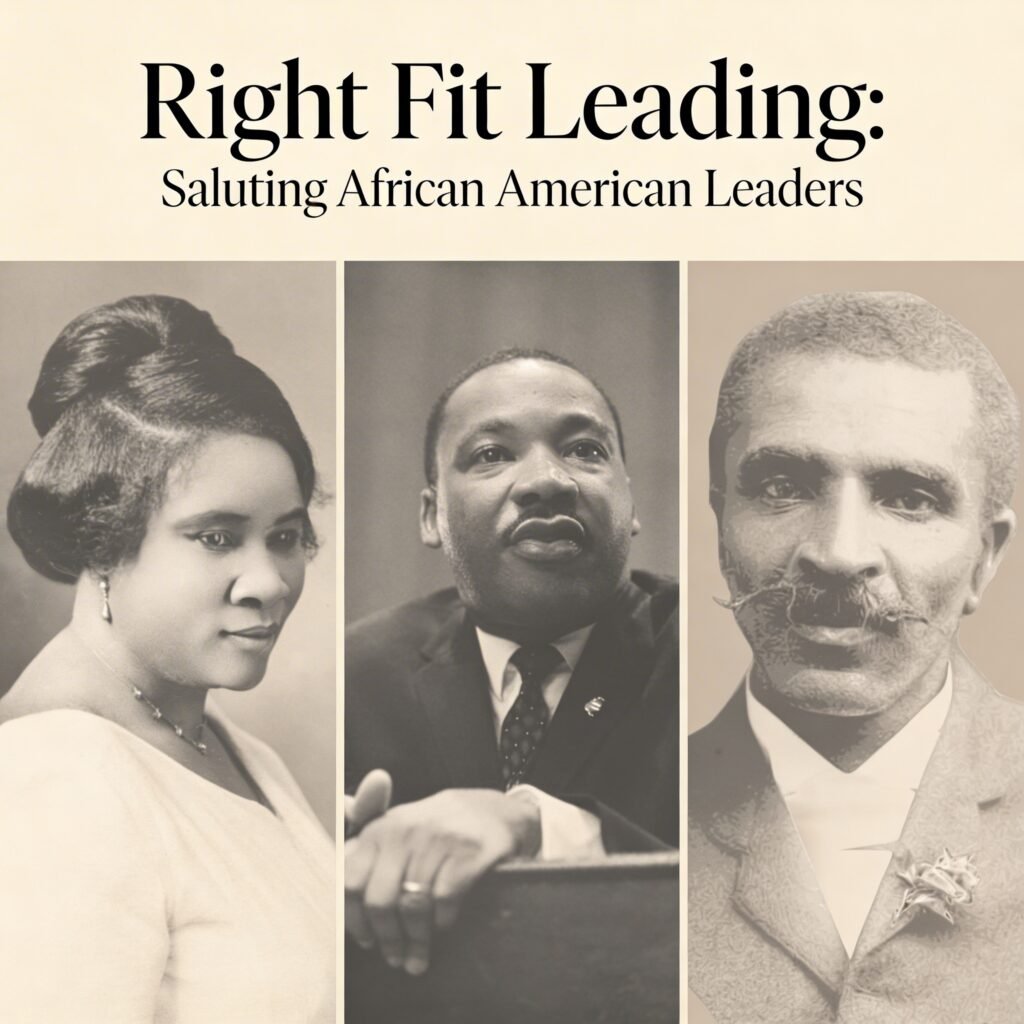
In honor of Black History Month, we want to highlight a few leaders from the National Archives and other sources. Please feel free to think about some of the countless others we can emulate. Our voice is more important than ever. Stay curious, find the data, and share informed messages using your voice. Martin Luther King, Jr. (January 15, 1929 – April 4, 1968) Image by WikiImages from Pixabay Dr. Martin Luther King, Jr. was one of the most important and influential Civil Rights leaders in the 1950s and 1960s. The cornerstones of his activism were based on non-violence and civil disobedience, both of which were inspired by his Christian faith and the teachings of Mahatma Gandhi. His words live on today. Madam C.J. Walker (1867-1919) https://www.history.com/articles/madame-c-j-walker Creating a line of hair products geared toward Black hair propelled Madam C.J. Walker to be the first African American woman to be a self-mad millionaire. According to Oprah Daily, “rst African American woman to become a self-made millionaire after creating a line of hair She created the first, Madam Walker’s Wonderful Hair Grower, in 1905. A Netflix series based upon her life, Self Made, premiered in March 2020.” George Washington Carver (1864-1943) Image by OpenClipart-Vectors  from Pixabay George Washington Carver was an agricultural chemist who wanted to increase the profitability of peanuts and sweet potatoes. His experiments in 1896 (revealed in 1914) led to 518 new products from the crops, including ink, dye, soap, cosmetics, flour, vinegar, and synthetic rubber. He is also known for giving us peanut butter. There are others, Barack and Michelle Obama, Kamala Harris, Shirley Chisholm, Gen. Benjamin O. Davis, Malcolm X, Stevie Wonder, Jesse Owens and others too numerous to mention. There are countless others who created our past, present, and future. Salute them all! Honor them all!  #BlackHistoryMonth

Right Fit Leading: Saluting African American Leaders Read More »

leadership development through communication

Leadership Development Through Communication and Emotional Intelligence: Motivationally Intelligent Leadership

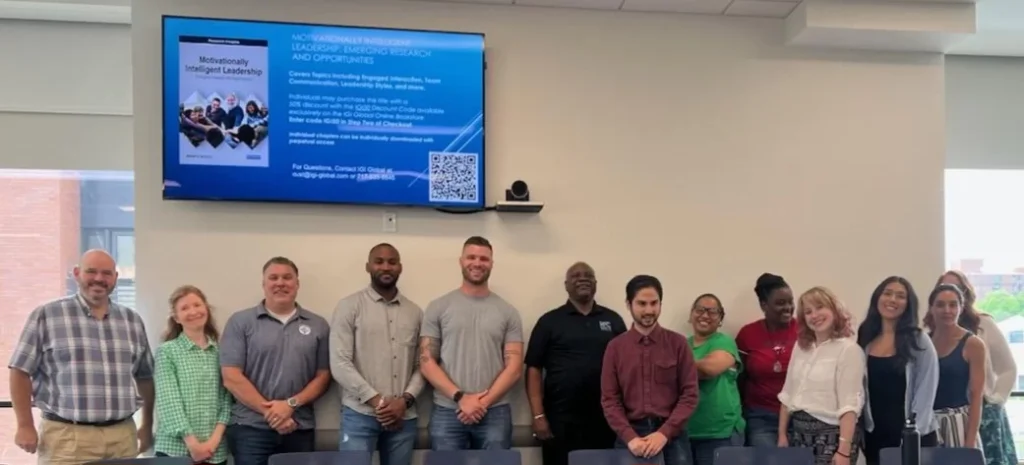
I want to share thoughts on this using my book Motivationally Intelligent Leadership: Emerging Research and Opportunities. Leaders should begin and end with emotional intelligence (EI). The leader who follows this approach recognizes and employs their own emotions to effectively interact with their team. These principles are equally valuable for organizations working with renewable energy digital & social media PR teams or any strategic communications and public relations firm where communication excellence drives performance. Effective leaders can deliver value to each party involved in the process and can achieve buy-in through good information-sharing approaches. A motivationally intelligent leader also employs engaged interaction characterized by flexible, full-range communications to ensure that all parties listen, hear, and understand. True engagement comes when everyone continues to interact until management and team-building objectives are satisfied—a standard also emphasized in corporate communications agencies in Washington DC, brand reputation management consultancies, and thought leadership PR agencies in the USA. EI is a theory that organizations can use to determine the desired behaviors for success. It provides a basis to understand employees, because it is the ability to sense, understand, and effectively apply the power and acumen of emotions as a source of human energy, information, trust, creativity, and influence. Those who possess EI can effectively acknowledge and value feelings in themselves and in others and can respond to those feelings in an effective way. Paying attention to emotions can save the leader time by allowing him or her to direct energies more effectively and by expanding opportunities. This type of emotional awareness also benefits fields like digital marketing + public relations services, where communication strategy relies heavily on understanding audiences. EI has three driving forces: building trusting relationships, increasing energy and effectiveness, and creating the future. The bottom line is that EI requires that you know yourself and your emotions. It requires honest self-analysis and an ability to manage your emotions. In terms of those around you, it requires empathy. Empathy is important for leaders who pay attention to EI in the workplace. Ronald E. Wheeler, Director of the Fineman and Pappas Law Libraries at Boston University School of Law provides excellent insight on empathy. Many modern communication sectors, including battery storage and renewables PR companies, also depend on empathy to strengthen stakeholder engagement. “Simply put, empathy is the ability to understand and share the feelings of others. People lacking empathy might be self-centered, narcissistic, or even sociopathic. Empathy helps you to be a good collaborator because it allows you to better understand the effects that your actions have on others. It helps you to see things through the eyes of others and to anticipate the wants and needs of others in the workplace. It allows you to be a more compassionate and kinder human being. Moreover, it helps you to avoid misunderstanding others’ intentions (Wheeler 2016).” What we know about EI goes beyond empathy. A couple of studies are relevant to our examination. A group of researchers conducted a meta-analysis to understand how leaders’ EI relates to subordinates’ job satisfaction (Miao, Humphrey et al. 2016). EI can lead to job satisfaction, according to the findings of that study, which stated in part that emotionally savvy leaders tend to promote an emotionally intelligent organizational culture. The study contends that EI culture demonstrates a focus on good personnel development through training. In this environment, employees can deal well with negative feelings and enter nurturing interactions. Many audience targeting & message development agencies rely on this type of culture to craft resonant communication. This suggests that communication can improve in this EI-infused situation. Also in 2016, a study titled “Manager emotional intelligence and project success: The mediating role of job satisfaction and trust,” analyzed data from 373 managers in the Australian Defense industry (Rezvani, Chang et al.). The study results demonstrated that EI has a positive impact on project success, job satisfaction, and trust. EI managers are well-equipped to deal with negative emotions and stress in the workplace. They can control their emotions while working toward a productive outcome for all parties involved. This ability is also a major asset in M&A communications and crisis PR, where emotional intelligence stabilizes high-pressure situations. Controlled emotions allow the leader to think strategically. This strategic focus allows trust-building through lowering anxiety levels in the office, balancing the leader’s self-interest with that of team members, being open about mistakes and not placing blame, and being consistent. If, for instance, the focus is on finding solutions instead of placing blame, then team members can enjoy their jobs while performing at a prominent level. This approach is equally applicable in integrated marketing & PR for associations as well as media relations and stakeholder communications consultancies. Social networking focused on EI and empathy tends to improve employee engagement and productivity. The collaborative communications that result from EI-based practices lead to shared understanding and win-win outcomes for everyone. Two key predictors of problems are lack of open and honest communications and lack of accountability. If your team lacks collaborative communication or if there is an absence of accountability throughout the organization, Motivationally Intelligent Leadership can help. We also must examine the challenges of face-to-face versus online communication. Face-to-face interactions are two-way communications, which is not always the case with online interactions. Success requires a connection between the parties. In other words, the outcome should be a shared understanding of the intent of the communication. This can most effectively happen by restating the conclusion and agreeing that all parties understand the same outcome. According to the chart for online interactions, the idea forms quickly, the communication features short bursts of activity, and the sender must evaluate the meaning of any feedback received. That feedback is either immediate or missing based on the platform and the sender’s point of view. But the parties must exchange feedback to be successful. Just like in face-to-face communication, it is important to restate the conclusion and agree on the outcome. Here are tips to consider when determining your networking strategy:


Leadership Development Through Communication and Emotional Intelligence: Motivationally Intelligent Leadership Read More »

RFL: Keys to Networking

I just read a post about declining bad LinkedIn connections, and it reminds me of ways to conduct effective networking. The post I read was correct in suggesting that you should read the profile of your intended connection and try to understand whether they might be interested in your connection request or message. Additionally, it is good to see if you have mutual connections with the person on LinkedIn or in other ways. Performing this check allows you to use your current network to see if there might be a fit. Even if you get the connection, the work is not done. You must work on being a good connection. I have some simple guidelines for my networking activity and for what I expect from others. Check in from time to time to say hello and refresh the connection. Any time you check in, state your purpose up front: pitch, offer, refresh the connection, whatever. If the person is not interested, go away. For everyone, if the connection is not rewarding in some way, disconnect. Remember, we can always delete! In terms of my list, if those I connect are not satisfying these rules, I can delete or disconnect or unfollow. And if I am not following the rules of others, they should abandon me. Make networking work for you by ensuring that it gives you value and shared understanding.

RFL: Keys to Networking Read More »

35542 1 1

Executive Leadership Session

I enjoyed today\’s great session with the energetic students at the University of Connecticut at Hartford\’s Executive Leadership Course. During our session, we discussed The Right Fit Leading Process, building emotionally-intelligent teams, creating relationships, and achieving shared understanding. We then progressed to analyzing case studies to closely examine trust in terms of how it is developed and nurtured. I want to thank Dr. Mohamad Alkadry, director of the UCONN School of Public Policy, for this opportunity to engage.

Executive Leadership Session Read More »

personal 1264695 1920

Improving Your emotional Intelligence

I had a great day today presenting Improving Your Emotional Intelligence: Creating a Win-Win Collaborative Culture. I gave the speech to a client conference in Chicago with more than 100 attendees. What was the highlight of my interactive presentation? The importance of remembering that a win-win collaborative culture leads to shared understanding. There are many things you can talk about when building or improving your culture. You can discuss emotional intelligence, empathy, engagement, organizational development, or even about training. My main point is that the win-win and shared understanding aspects are what make my presentation a little different than others.

Improving Your emotional Intelligence Read More »

a3 poster 1296448 340 e1504527875599

RFL: Collaborative Leadership

Collaborative leadership is a non-traditional way to address organizational development. By training leaders and those they lead together, this approach allows skill development in philosophy, inspiration, and motivation. This approach focuses on collaborative ways to create effective relationships and effective teams. Using emotional intelligence (EI) and empathy, leaders get in touch with those they lead. They look to master their own emotions and those of others. This approach relies on effective engagement, and it fosters the pursuit of win-win situations that create shared understanding. In addition, organizational relationships improve as trust develops, and as cultural developments are observed. NOTE: The Right Fit Leading (RFL) Process addresses the need to change the focus of training from the traditional leader-centric philosophy to one of engagement, interaction, and collaboration. This creates an atmosphere where leaders and those they lead have equal opportunities to affect the leader-follower relationship that is required in effective teams. The RFL Process promotes the creation of effective teams because it is based on emotional intelligence and empathy for all members, regardless of their position or level of responsibility. The RFL Process addresses a consistent philosophy of how we lead and follow. It suggests that we must inspire ourselves and others. It also demonstrates the need to motivate ourselves and others to take on challenges that we might not attempt otherwise. We use emotional intelligence (EI) and empathy, engagement, LMX Theory, and knowledge about the meaning of trust and how it is developed and nurtured. At this point, development can turn its focus to what is needed for each leader and member. We use the principle of engaged interaction to help leader and team development subjects arrive at a shared understanding.

RFL: Collaborative Leadership Read More »

freepik img1 use the same sames uniform black corporate su 61729

RFL: Leadership is an Action

Leadership is not about what you say, it is about what you do. The key to leadership is whether what you do resonates with those you lead. If you are emotionally intelligent, empathic, engaging, and collaborative, it should be evident in your actions. This is just as important as what you say. If you listen intently and adjust to the feedback you’re receiving, it will influence and motivate actions that matter. What I’m talking about is sharing your skills and your passion with those you lead. Seek out win-win relationships that strive for shared understanding and, when you don’t have it, stop and work on it. Leadership is a state of mind that you should share with your team. The team is watching you, and the team will follow you if your actions are worthy of it. More important, they will be your partners in achieving mission accomplishment. NOTE: The Right Fit Leading (RFL) Process addresses the need to change the focus of training from the traditional leader-centric philosophy to one of engagement, interaction, and collaboration. This creates an atmosphere where leaders and those they lead have equal opportunities to affect the leader-follower relationship that is required in effective teams. The RFL Process promotes the creation of effective teams because it is based on emotional intelligence and empathy for all members, regardless of their position or level of responsibility. The RFL Process addresses a consistent philosophy of how we lead and follow. It suggests that we must inspire ourselves and others. It also demonstrates the need to motivate ourselves and others to take on challenges that we might not attempt otherwise. We use emotional intelligence (EI) and empathy, engagement, LMX Theory, and knowledge about the meaning of trust and how it is developed and nurtured. At this point, development can turn its focus to what is needed for each leader and member. We use the principle of engaged interaction to help leader and team development subjects arrive at a shared understanding.

RFL: Leadership is an Action Read More »

ei trust lmx small

RFL: Building Trust

Trust is important in every organization and every leader should be actively building trust. This is done through continuous engagement in a collaborative relationship. The relationship allows trust to develop. Leaders can nurture that development by instilling in every member an understanding of their value to the group. Building trust in this way can contribute to achieving organizational goals and to encouraging cooperation from all members. Collaboration supports trusting relationships when it creates an environment that allows people to share work. It allows participants to understand each person’s situation and it creates open and honest group communications. Leaders can be effective when they engage at all levels of the organization. Engagement helps employees see their value through a win-win collaboration that creates shared understanding. Trust is also stronger when leaders and members share feedback, especially when someone misses the interaction for whatever reason.

RFL: Building Trust Read More »

leader member development overview wheel small

RFL: Develop Leadership

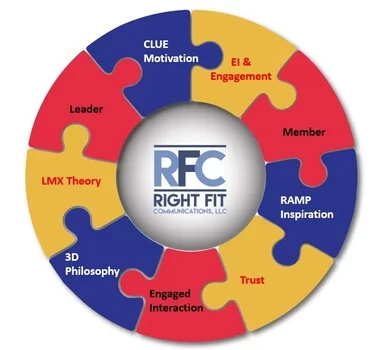
One cannot develop leadership by only focusing on the leader and which of their skills need development or improvement. Using Leader-Member Exchange (LMX) Theory, you can understand that leadership development is best done by developing and/or improving the skills of both the leader and those they lead. This approach leads to shared understanding that allows effective team building. The Right Fit Leading (RFL) Process addresses this challenge. RFL characterizes leader and team development in terms of three key components. Good leadership and followership are tied to each other, whether they are taught and trained that way or not. Current research supports the belief that good leadership is about philosophy, inspiration, and motivation. The RFL Process is based on emotional intelligence and empathy for all members of any team, regardless of their position or level of responsibility. The RFL Process addresses a consistent philosophy of how we lead and follow. It suggests that we must inspire ourselves and others. It also demonstrates the need to motivate ourselves and others to take on challenges that we might not attempt otherwise. So, the RFL Process is instrumental in leader and team development. It starts with the three major parts my vision: 3D Philosophy, RAMP Inspiration, and CLUE Motivation. The next step is in understanding the tools that are most helpful. For that, we use emotional intelligence (EI) and engagement, LMX, and knowledge about the meaning of trust and how it is developed and nurtured. At this point, development can turn its focus to what is needed for each leader and member. We use the principle of engaged interaction to help development subjects arrive at a shared understanding. This is a formula for organizational and leadership development success. Please let me know if you want like more information on the RFL Process.

RFL: Develop Leadership Read More »

0