Leading

1 2 (1)

Right Fit Leading: Great Leadership in Action

The other day I went to lunch and was captivated to see great leadership in action. I was at a Chik-Fil-A and I watched the managers and the team members work seamlessly in support of every customer. The managers were active, alert, and involved. The team members were enthusiastic and shared information freely with managers and with other members. This team was impressive! If you need help building your team, here are a couple of discounted book suggestions for you. Right Fit Leading: Emotionally Intelligent Team Building 3D COACHING: Suggestions for a New Approach

Right Fit Leading: Great Leadership in Action Read More »

leader member development overview wheel small

RFL: Develop Leadership

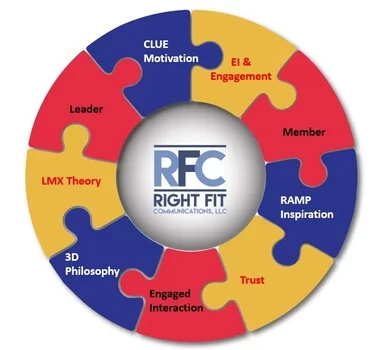
One cannot develop leadership by only focusing on the leader and which of their skills need development or improvement. Using Leader-Member Exchange (LMX) Theory, you can understand that leadership development is best done by developing and/or improving the skills of both the leader and those they lead. This approach leads to shared understanding that allows effective team building. The Right Fit Leading (RFL) Process addresses this challenge. RFL characterizes leader and team development in terms of three key components. Good leadership and followership are tied to each other, whether they are taught and trained that way or not. Current research supports the belief that good leadership is about philosophy, inspiration, and motivation. The RFL Process is based on emotional intelligence and empathy for all members of any team, regardless of their position or level of responsibility. The RFL Process addresses a consistent philosophy of how we lead and follow. It suggests that we must inspire ourselves and others. It also demonstrates the need to motivate ourselves and others to take on challenges that we might not attempt otherwise. So, the RFL Process is instrumental in leader and team development. It starts with the three major parts my vision: 3D Philosophy, RAMP Inspiration, and CLUE Motivation. The next step is in understanding the tools that are most helpful. For that, we use emotional intelligence (EI) and engagement, LMX, and knowledge about the meaning of trust and how it is developed and nurtured. At this point, development can turn its focus to what is needed for each leader and member. We use the principle of engaged interaction to help development subjects arrive at a shared understanding. This is a formula for organizational and leadership development success. Please let me know if you want like more information on the RFL Process.

RFL: Develop Leadership Read More »

18

Right Fit Leading: Focus on Engagement

Let us talk about engagement. A common misunderstanding focuses on whether and how much engagement is involved. A 2012 study concerning engagement (Stillman, 2012) illustrates the great disagreement in the way leaders and their employees view engagement. In this study, CEOs, employees, and human resources professionals each answered questions about how they view their company in terms of engagement. The answers are very different in each group. More than half of the CEOs surveyed believe that spontaneous feedback, or engagement, happens frequently in their organization. Also, more than 60 percent of employees cited a preference for immediate feedback, or engagement. However, less than 25 percent said it is something they receive. Additionally, just 11 percent of the human resources people surveyed believed that employees receive immediate feedback. Finally, leaders, employees, and human resources professionals differed greatly on the existence of and frequency of recognition. Because these three groups view feedback differently, we must reconsider our understanding of engagement. Yes, engagement is a powerful tool. Engagement requires communicating to achieve shared understanding. Engagement can also suggest policy or procedure adjustments once we identify an issue. The goal for leaders is that they practice and pursue engagement to achieve that shared understanding. Do you engage on a regular basis? Stillman, J. (2012). Do Bosses and Employees See Eye to Eye on Anything? Inc.com. Retrieved from https://www.inc.com/jessica-stillman/do-bosses-and-employee-see-eye-to-eye-on-anything.html


Right Fit Leading: Focus on Engagement Read More »

blog logo without silhouettes

3D COACHING: Notes for Success

I always think in terms of the three Ds. Success has a price. That price is dedication to the task at hand through hard work. That price is being determined to do the best you can, win or lose. That price is applying the best of yourself to everything you do. Paying attention to detail means demonstrating to your team, and yourself, that it is necessary to focus on the journey, not just today’s goal. Learning the right way to compete is vital to having the confidence to grow as a person and as a team member. The leader’s job is to create the perfect conditions for success by teaching techniques and strategy. Once that is accomplished your team can use their talents and their wits to grow and win. Discipline is important all the time, but it takes on more importance when things go wrong. You cannot change what happens, but your discipline provides you with the tools to change your approach, your attitude, and/or your response. Discipline guides your ability to avoid complaining in troubled times and instead working with your team to figure out how to make things better. 3D COACHING: Suggestions for a New Approach

3D COACHING: Notes for Success Read More »

imgbin agencia nacional del espectro 0 information working group statute png small

Right Fit Leading: Collaborate BEFORE You Implement

Use collaboration when setting the “next” plan that will bring organizational success. Leaders are often excited to create their grand plan either when they find that “best new way” or when they take over a new job and set out to improve things. In both cases, leaders expect their team to be just as excited about this new plan as they are. The same leaders may find disappointment when their team does not respond positively to the plan. If your people do not understand your plan because you have not adequately explained the purpose and procedures, they will probably be slow to jump for joy. More important, if the team has reservations and you have already set the new plan in motion, you may meet with strong emotions against this new initiative. You may encounter big problems if you do not socialize the plan with your team before implementing. I am not saying that the leader must get approval of the plan from subordinates and colleagues. I am not saying the leader must achieve buy-in before the plan can work. What I am saying is that collaboration as the plan is developed allows the change to be built in, not bolted on. When people are given the opportunity to build the plan along the way they are far more interested and motivated to see it through to success. The collaborative approach works because it keeps everyone on the same page and it identifies challenges along the way. This is about team. How do you implement new plans?

Right Fit Leading: Collaborate BEFORE You Implement Read More »

Thoughts from a Coach

The late Vince Lombardi, hall of fame Green Bay Packers football coach, said, “Coaches who can outline plays on a blackboard are a dime a dozen.  The ones who win get inside their player and motivate.” Many of us are neither coaching nor playing sports right now, so I have had plenty of time to reflect on coaching.  Any thoughts I have on coaching are always fueled by how to motivate myself and my players to success. A good motivator helps by developing a shared understanding of the task at hand.  That is followed by demonstrating to those you want to motivate that they may not always be judged simply by winning and losing, because not everyone wins.  Show them that they are judged by the quality of each hour they spend accomplishing tasks.  Show them that their efforts tie directly to the benefits they will derive from participation. In return, these motivated people will decide what they want and then direct all their efforts on getting it.

Thoughts from a Coach Read More »

0