trust

Saluting African American Leaders

Right Fit Leading: Saluting African American Leaders

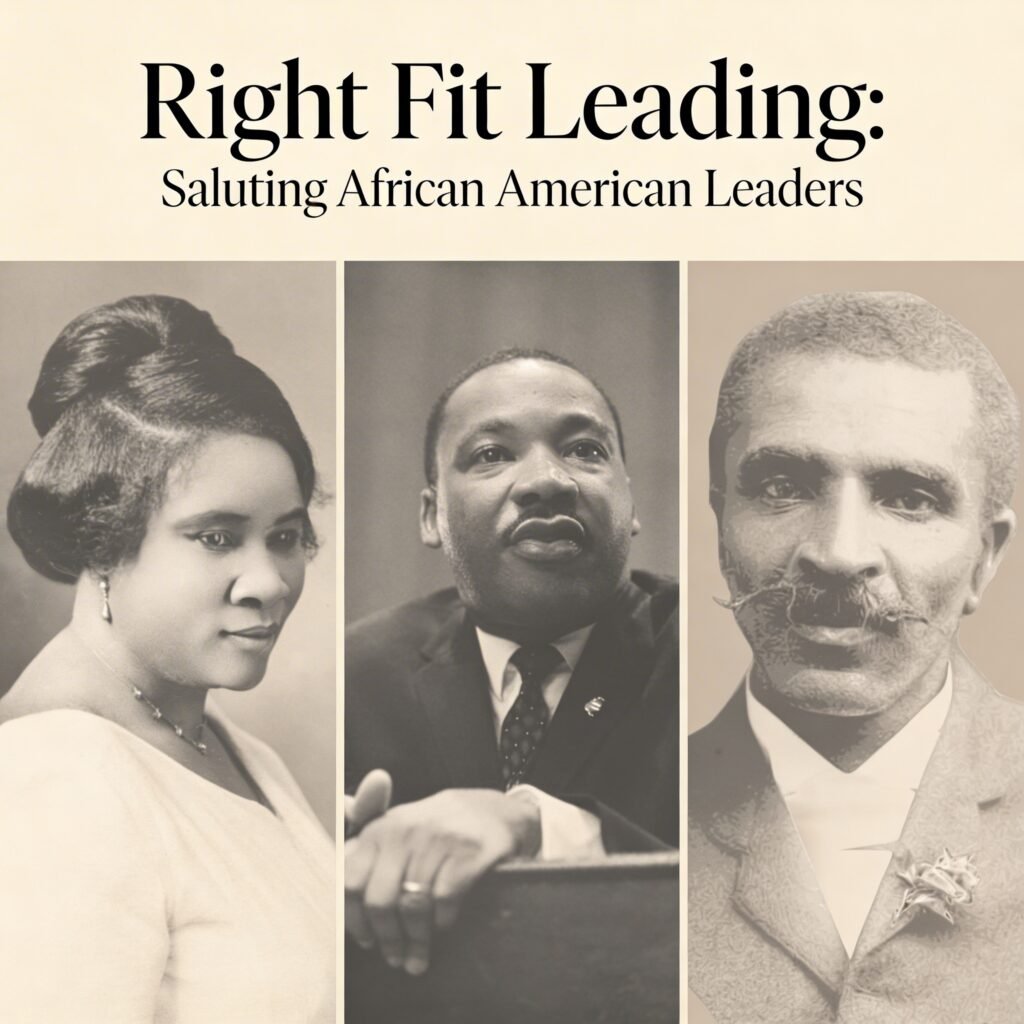
In honor of Black History Month, we want to highlight a few leaders from the National Archives and other sources. Please feel free to think about some of the countless others we can emulate. Our voice is more important than ever. Stay curious, find the data, and share informed messages using your voice. Martin Luther King, Jr. (January 15, 1929 – April 4, 1968) Image by WikiImages from Pixabay Dr. Martin Luther King, Jr. was one of the most important and influential Civil Rights leaders in the 1950s and 1960s. The cornerstones of his activism were based on non-violence and civil disobedience, both of which were inspired by his Christian faith and the teachings of Mahatma Gandhi. His words live on today. Madam C.J. Walker (1867-1919) https://www.history.com/articles/madame-c-j-walker Creating a line of hair products geared toward Black hair propelled Madam C.J. Walker to be the first African American woman to be a self-mad millionaire. According to Oprah Daily, “rst African American woman to become a self-made millionaire after creating a line of hair She created the first, Madam Walker’s Wonderful Hair Grower, in 1905. A Netflix series based upon her life, Self Made, premiered in March 2020.” George Washington Carver (1864-1943) Image by OpenClipart-Vectors  from Pixabay George Washington Carver was an agricultural chemist who wanted to increase the profitability of peanuts and sweet potatoes. His experiments in 1896 (revealed in 1914) led to 518 new products from the crops, including ink, dye, soap, cosmetics, flour, vinegar, and synthetic rubber. He is also known for giving us peanut butter. There are others, Barack and Michelle Obama, Kamala Harris, Shirley Chisholm, Gen. Benjamin O. Davis, Malcolm X, Stevie Wonder, Jesse Owens and others too numerous to mention. There are countless others who created our past, present, and future. Salute them all! Honor them all!  #BlackHistoryMonth

Right Fit Leading: Saluting African American Leaders Read More »

leadership development through communication

Leadership Development Through Communication and Emotional Intelligence: Motivationally Intelligent Leadership

I want to share thoughts on this using my book Motivationally Intelligent Leadership: Emerging Research and Opportunities. Leaders should begin and end with emotional intelligence (EI). The leader who follows this approach recognizes and employs their own emotions to effectively interact with their team. These principles are equally valuable for organizations working with renewable energy digital & social media PR teams or any strategic communications and public relations firm where communication excellence drives performance. Effective leaders can deliver value to each party involved in the process and can achieve buy-in through good information-sharing approaches. A motivationally intelligent leader also employs engaged interaction characterized by flexible, full-range communications to ensure that all parties listen, hear, and understand. True engagement comes when everyone continues to interact until management and team-building objectives are satisfied—a standard also emphasized in corporate communications agencies in Washington DC, brand reputation management consultancies, and thought leadership PR agencies in the USA. EI is a theory that organizations can use to determine the desired behaviors for success. It provides a basis to understand employees, because it is the ability to sense, understand, and effectively apply the power and acumen of emotions as a source of human energy, information, trust, creativity, and influence. Those who possess EI can effectively acknowledge and value feelings in themselves and in others and can respond to those feelings in an effective way. Paying attention to emotions can save the leader time by allowing him or her to direct energies more effectively and by expanding opportunities. This type of emotional awareness also benefits fields like digital marketing + public relations services, where communication strategy relies heavily on understanding audiences. EI has three driving forces: building trusting relationships, increasing energy and effectiveness, and creating the future. The bottom line is that EI requires that you know yourself and your emotions. It requires honest self-analysis and an ability to manage your emotions. In terms of those around you, it requires empathy. Empathy is important for leaders who pay attention to EI in the workplace. Ronald E. Wheeler, Director of the Fineman and Pappas Law Libraries at Boston University School of Law provides excellent insight on empathy. Many modern communication sectors, including battery storage and renewables PR companies, also depend on empathy to strengthen stakeholder engagement. “Simply put, empathy is the ability to understand and share the feelings of others. People lacking empathy might be self-centered, narcissistic, or even sociopathic. Empathy helps you to be a good collaborator because it allows you to better understand the effects that your actions have on others. It helps you to see things through the eyes of others and to anticipate the wants and needs of others in the workplace. It allows you to be a more compassionate and kinder human being. Moreover, it helps you to avoid misunderstanding others’ intentions (Wheeler 2016).” What we know about EI goes beyond empathy. A couple of studies are relevant to our examination. A group of researchers conducted a meta-analysis to understand how leaders’ EI relates to subordinates’ job satisfaction (Miao, Humphrey et al. 2016). EI can lead to job satisfaction, according to the findings of that study, which stated in part that emotionally savvy leaders tend to promote an emotionally intelligent organizational culture. The study contends that EI culture demonstrates a focus on good personnel development through training. In this environment, employees can deal well with negative feelings and enter nurturing interactions. Many audience targeting & message development agencies rely on this type of culture to craft resonant communication. This suggests that communication can improve in this EI-infused situation. Also in 2016, a study titled “Manager emotional intelligence and project success: The mediating role of job satisfaction and trust,” analyzed data from 373 managers in the Australian Defense industry (Rezvani, Chang et al.). The study results demonstrated that EI has a positive impact on project success, job satisfaction, and trust. EI managers are well-equipped to deal with negative emotions and stress in the workplace. They can control their emotions while working toward a productive outcome for all parties involved. This ability is also a major asset in M&A communications and crisis PR, where emotional intelligence stabilizes high-pressure situations. Controlled emotions allow the leader to think strategically. This strategic focus allows trust-building through lowering anxiety levels in the office, balancing the leader’s self-interest with that of team members, being open about mistakes and not placing blame, and being consistent. If, for instance, the focus is on finding solutions instead of placing blame, then team members can enjoy their jobs while performing at a prominent level. This approach is equally applicable in integrated marketing & PR for associations as well as media relations and stakeholder communications consultancies. Social networking focused on EI and empathy tends to improve employee engagement and productivity. The collaborative communications that result from EI-based practices lead to shared understanding and win-win outcomes for everyone. Two key predictors of problems are lack of open and honest communications and lack of accountability. If your team lacks collaborative communication or if there is an absence of accountability throughout the organization, Motivationally Intelligent Leadership can help. We also must examine the challenges of face-to-face versus online communication. Face-to-face interactions are two-way communications, which is not always the case with online interactions. Success requires a connection between the parties. In other words, the outcome should be a shared understanding of the intent of the communication. This can most effectively happen by restating the conclusion and agreeing that all parties understand the same outcome. According to the chart for online interactions, the idea forms quickly, the communication features short bursts of activity, and the sender must evaluate the meaning of any feedback received. That feedback is either immediate or missing based on the platform and the sender’s point of view. But the parties must exchange feedback to be successful. Just like in face-to-face communication, it is important to restate the conclusion and agree on the outcome. Here are tips to consider when determining your networking strategy:

Leadership Development Through Communication and Emotional Intelligence: Motivationally Intelligent Leadership Read More »

35542 1 1

Executive Leadership Session

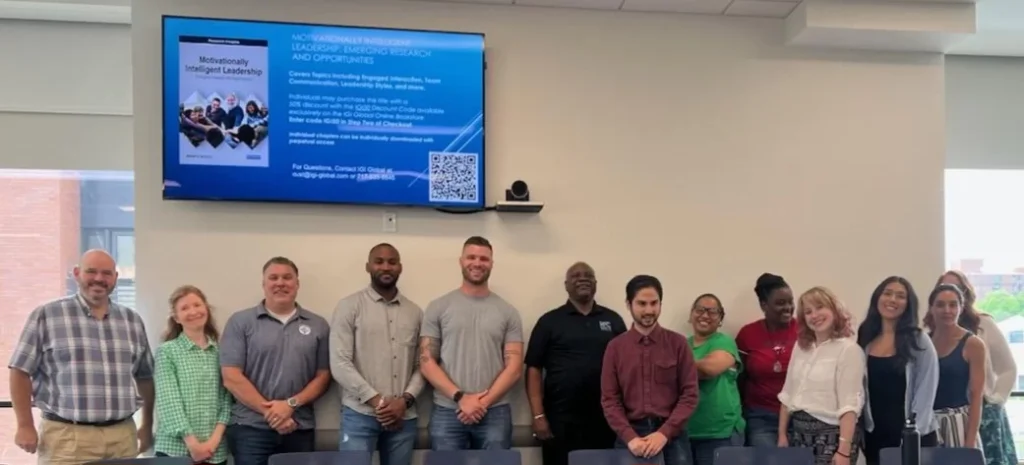
I enjoyed today\’s great session with the energetic students at the University of Connecticut at Hartford\’s Executive Leadership Course. During our session, we discussed The Right Fit Leading Process, building emotionally-intelligent teams, creating relationships, and achieving shared understanding. We then progressed to analyzing case studies to closely examine trust in terms of how it is developed and nurtured. I want to thank Dr. Mohamad Alkadry, director of the UCONN School of Public Policy, for this opportunity to engage.

Executive Leadership Session Read More »

ei trust lmx small

RFL: Building Trust

Trust is important in every organization and every leader should be actively building trust. This is done through continuous engagement in a collaborative relationship. The relationship allows trust to develop. Leaders can nurture that development by instilling in every member an understanding of their value to the group. Building trust in this way can contribute to achieving organizational goals and to encouraging cooperation from all members. Collaboration supports trusting relationships when it creates an environment that allows people to share work. It allows participants to understand each person’s situation and it creates open and honest group communications. Leaders can be effective when they engage at all levels of the organization. Engagement helps employees see their value through a win-win collaboration that creates shared understanding. Trust is also stronger when leaders and members share feedback, especially when someone misses the interaction for whatever reason.

RFL: Building Trust Read More »

leader member development overview wheel small (1)

The Right Fit Leading Process

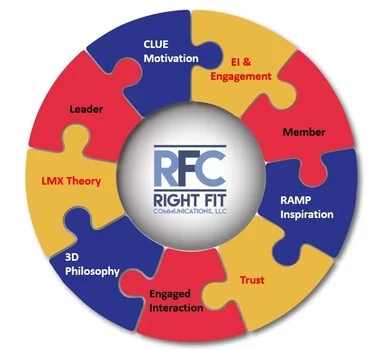
The Right Fit Leading Process is not new. What is new is the way that new research in the areas of emotional intelligence, empathy, trust, team development. That means a host of other leadership considerations have come together for me. It is now clearer than ever that the way to build successful organizations is to develop leaders and members together and let them engage to find shared understanding. It is no longer enough to develop leaders. We must build teams where leaders and those they lead partner in developing philosophy, inspiration, and motivation. The Right Fit Leading Process has as its foundation emotional intelligence and empathy. These are collaboratively developed for the leader and the member or follower. We use engaged interaction to develop leaders and members at the same time through collaborative training methods. The basics of our focus always include EI and engagement, LMX Theory, and trust. The process focuses on a consistent philosophy of the way we lead and follow. The process suggests that all members of the organization have a responsibility to inspire themselves and others. That means the organization needs work relationships where people at all levels motivate themselves and others to take on challenges that they might not attempt otherwise. The process can help leaders and those they lead in diverse types of organizations and industries. The process can develop teams, leaders, and members, promoting trust, engagement, and other benefits that can lead to success and growth. Please contact me if you want to know more about the Right Fit Leading Process.   NOTE: Graphic courtesy of Hafsa Akhter, SA Digitech

The Right Fit Leading Process Read More »

trust and work location preview small

Right Fit Leading: Let’s Talk Trust!

Trust is important. It is a key consideration as companies and employees engage in understanding and addressing their work-life relationship. When they engage, they often discuss work location: onsite versus hybrid versus remote work. Several experts in these areas have joined in analyzing how trust is a major issue in these deliberations. These experts are working on a new project to share those findings, but here are some trust highlights. Dr. Michael Brown When companies talk with their people about work location, they are often talking about trust and engagement and interaction with employees. Those who address and manage these trust issues may have easier decisions on location and process. Leslie Krohn In a trusting environment, supervisors can be honest about where work can happen. Trust allows employees to be honest about how and where they plan to work. This is important because everyone’s situation is different and every organization is different. Honesty and trust ensure a good, productive, sustainable outcome. James Goodwin The conversation almost certainly shifts back to the issue of trust. That means that if an employee can’t be effective where they’re physically located, it does not really make a difference, right? Deirdre Breakenridge What I’ve experienced in my career is that all work-related roads lead back to trust. The trust you have in your employees, and the trust they have in you.

Right Fit Leading: Let’s Talk Trust! Read More »

about (1)

Right Fit Leading: Telework Has a Bad Reputation

Telework has a bad reputation. This can be caused when employers and employees fail to understand it. Companies may fail to see the ability for the employee to be as productive whether in the the office or working remotely. Remote employees may fail to be accountable for 8 or so productive hours of tangible work each day. The company may not have a process to address these issues. Or, the company may lack a process that is clear and easy to follow. Following standards and being accountable are difficult in these situations. Open, honest discussions about trust and work location are keys to success.

Right Fit Leading: Telework Has a Bad Reputation Read More »

18

Right Fit Leading: Focus on Engagement

Let us talk about engagement. A common misunderstanding focuses on whether and how much engagement is involved. A 2012 study concerning engagement (Stillman, 2012) illustrates the great disagreement in the way leaders and their employees view engagement. In this study, CEOs, employees, and human resources professionals each answered questions about how they view their company in terms of engagement. The answers are very different in each group. More than half of the CEOs surveyed believe that spontaneous feedback, or engagement, happens frequently in their organization. Also, more than 60 percent of employees cited a preference for immediate feedback, or engagement. However, less than 25 percent said it is something they receive. Additionally, just 11 percent of the human resources people surveyed believed that employees receive immediate feedback. Finally, leaders, employees, and human resources professionals differed greatly on the existence of and frequency of recognition. Because these three groups view feedback differently, we must reconsider our understanding of engagement. Yes, engagement is a powerful tool. Engagement requires communicating to achieve shared understanding. Engagement can also suggest policy or procedure adjustments once we identify an issue. The goal for leaders is that they practice and pursue engagement to achieve that shared understanding. Do you engage on a regular basis? Stillman, J. (2012). Do Bosses and Employees See Eye to Eye on Anything? Inc.com. Retrieved from https://www.inc.com/jessica-stillman/do-bosses-and-employee-see-eye-to-eye-on-anything.html

Right Fit Leading: Focus on Engagement Read More »

social small

Book Excerpt: Social Communication Research

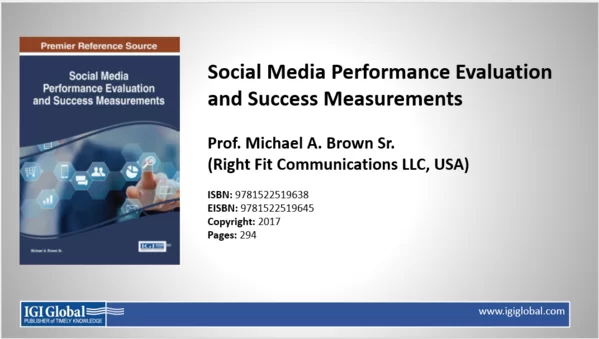
This work features some of my social communication research brought to publication thanks to IGI Global. You can purchase relevant chapters by selecting the link “Access This Chapter” at the bottom. Book Excerpt, Chapter 3, Page 47 This is an older work, but it is important to continue learning about and evaluating the use of digital communication. George Santayana said, “Those who cannot remember the past are condemned to repeat it.” That statement is the reason social communication is covered here with a historical view. This review of computer mediated communications (CMC) is helpful in understanding the nature of key developments. These led to the social media space we know today. Discussing the portable nature of various interactions is relevant as the foundation for a deep understanding of social communication. This is an important analysis in helping people understand the way we can use information technology to interact without the limitations of geographical distance and time. Access This Chapter!

Book Excerpt: Social Communication Research Read More »

citizen small

Book Excerpt: Predictors of social networking

Predictors: I am sharing excerpts from some of my works. You can purchase relevant chapters by selecting the link “Access This Chapter” at the bottom. Chapter 8, Predictors of Social Networking and Individual Performance, Michael A. Brown (Old Dominion University, USA) and Mohamad Alkadry (Florida International University, USA) Book Excerpt, Chapter 8, Page 129 Public organizations that can successfully predict participation and understand the value propositions that drive performance can be very effective in social networking, which is a process and practice by which people and organizations are drawn together by family, work, or hobby to interact via websites. This chapter examines the relationship between social networking and individual performance. It also suggests a social networking participation model that takes advantage of innovation adoption and other important theories to help public organizations understand acceptance or rejection of participation. In a recent study, responses from 191 public administrators were analyzed using structural equation modeling (SEM) to focus on the relationship between participation and five constructs: perceived usefulness, perceived ease of use, perceived improvement potential (PIP), intra-organizational trust, and type of use. The study demonstrates favorable model fit statistics that support positive correlations between the latent variables examined and the dependent variable, participation. The results demonstrate the potential of the survey instrument to serve as an adoption and participation methodology that can provide public organizations with knowledge that predicts and promotes social networking activities as they relate to perceived performance improvement. This approach arms organizations and leaders with a new lens with which to focus on the value proposition regarding perceived improvement potential based on social networking participation. Access To This Chapter! You can get access to all of my works here.

Book Excerpt: Predictors of social networking Read More »

0