Blog

canstockphoto55357238 scaled e1674171315568

Turned Down? Stay on the Path!

When job hunting, prepare yourself and then stay on the path. Have you received that polite “you have great qualifications, but we are not going to proceed with your application” turn down message? I have gotten a few, and I’ve even seen some of those jobs readvertised. I want to tell you that none of this has dampened my belief that there is opportunity out there for me. These things are not a reflection on your qualifications or your readiness for that opportunity. They are simply an indication that you were unable to match your skills to that employer’s needs. I urge you to stay on the path. I suggest that you’re probably on the right path and you only need course correction. If you feel that you have done good work on your resume, and that you always prepare for your interviews, then I suggest you are doing it right. If you’re not confident about it, you can certainly get a life coach, but you could also get a mentor or just talk it over with a friend who will give you honest feedback. I don’t know how long it will take for you to find the job that fits you, but the faith you have in yourself is more important that what anyone else thinks about you. I wish you luck. Stay on the path! Image: © Can Stock Photo / fizkes  

Turned Down? Stay on the Path! Read More »

20230119 093115 e1674143826146

Writing When You\’re Stuck

Thanks for the great discussions about “Writing When You’re Stuck” with the Write On! authors last night. We discussed how to tackle these common writing problems: – Don’t know how to start? – Don’t know what to write? – Trouble with a difficult topic? – Stuck on page 1, chapter 1? I shared with the group three things that help me when I have writer’s block or when I just need to get motivated. First, I watch the 2000 movie Finding Forrester with Sean Connery and Rob Brown. Second, I write whatever I am thinking or feeling at the time, even if it’s not the topic of the project at the time. I save whatever I write without judging at the time if it’s good or bad. Third, if one and two don’t work, I take a break. Good luck with YOUR writing!

Writing When You\’re Stuck Read More »

18

Right Fit Leading: Focus on Engagement

Let us talk about engagement. A common misunderstanding focuses on whether and how much engagement is involved. A 2012 study concerning engagement (Stillman, 2012) illustrates the great disagreement in the way leaders and their employees view engagement. In this study, CEOs, employees, and human resources professionals each answered questions about how they view their company in terms of engagement. The answers are very different in each group. More than half of the CEOs surveyed believe that spontaneous feedback, or engagement, happens frequently in their organization. Also, more than 60 percent of employees cited a preference for immediate feedback, or engagement. However, less than 25 percent said it is something they receive. Additionally, just 11 percent of the human resources people surveyed believed that employees receive immediate feedback. Finally, leaders, employees, and human resources professionals differed greatly on the existence of and frequency of recognition. Because these three groups view feedback differently, we must reconsider our understanding of engagement. Yes, engagement is a powerful tool. Engagement requires communicating to achieve shared understanding. Engagement can also suggest policy or procedure adjustments once we identify an issue. The goal for leaders is that they practice and pursue engagement to achieve that shared understanding. Do you engage on a regular basis? Stillman, J. (2012). Do Bosses and Employees See Eye to Eye on Anything? Inc.com. Retrieved from https://www.inc.com/jessica-stillman/do-bosses-and-employee-see-eye-to-eye-on-anything.html

Right Fit Leading: Focus on Engagement Read More »

innovative small

Book Excerpt: Hybrid Communication and Learning Approaches

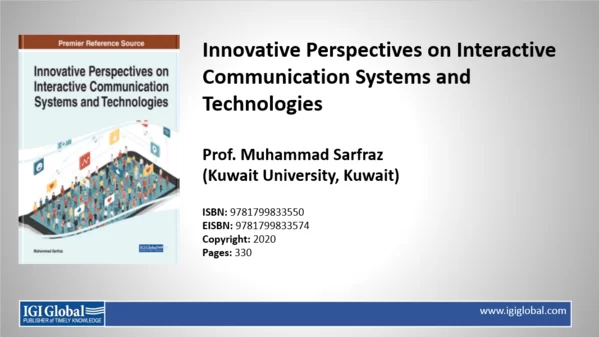
I am sharing excerpts from some of my works, including this one concerning hybrid communication and learning approaches. You can purchase relevant chapters by selecting the link “Access This Chapter” at the bottom. Book Excerpt, Chapter 11, Page 226 Today’s scholars discuss the importance of taking a hybrid approach to social communication. This hybrid effect combines the best of face-to-face and online choices. The approach also considers various influences on communications. My research in this area suggests an approach that combines the best of face-to-face and online communication. Also, some researchers suggest that even when online is the better method, it was more effective when combined with face-to-face interactions (M. A. Brown, 2017, p. 209). Everyone strives for the best possible message-medium fit tailored to the choice of media and type of use. This type of correct \”fit\” results in enhanced collaborations. Once you achieve that fit, you can focus on message, media-mix, task, online success, interaction partners, and other best practices (Bubaš, 2001). This work addresses the continued growth of the online space. This growth allows us to work toward a hybrid approach to combining face-to-face and online activities. The approach allows us to move to a discussion of the importance of trust in effective collaborations. We build trust, in part, by overcoming and adjusting to communication barriers. Building trust this way often leads to discussions about communication success and suggests the proposed hybrid approach. Access This Chapter!

Book Excerpt: Hybrid Communication and Learning Approaches Read More »

returning small

Book Excerpt: About Emotional Intelligence and empathy

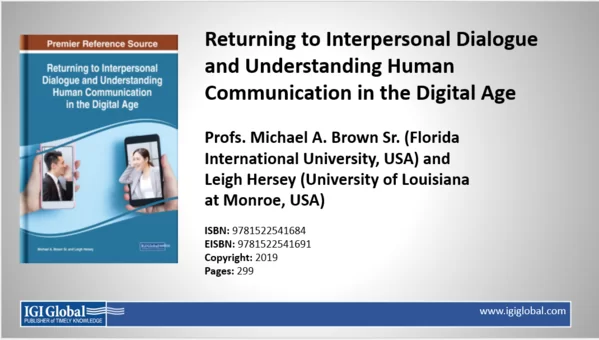
This excerpt offers good information on emotional intelligence (EI) and empathy. You can purchase relevant chapters by selecting the link “Access This Chapter” at the bottom. Book Excerpt, Chapter 10, Page 204 The rise of EI and the continuing growth of online interactions work together to demonstrate the importance of participatory decision making as a motivational technique. However, participation in decisions requires that the leader act in a prosocial manner, focusing on outcomes that are beneficial to more than just the leader. A prosocial attitude leads to creation of buy-in through shared value and good management of emotions, requiring skill in both EI and empathetic approaches. EI is about connecting with one\’s own emotions and those of others to enable effective leadership communication. Empathy is the ability to understand someone else\’s emotions, feel them as if they were yours, and even to take some action in support or mitigation of those feelings. The lack of feedback or agreements on shared value in online interactions are highlighted when people are forced into face-to-face interactions and are subsequently unable to find these important communication tools. This chapter offers a new approach to leadership communication. Access This Chapter!

Book Excerpt: About Emotional Intelligence and empathy Read More »

social small

Book Excerpt: Social Communication Research

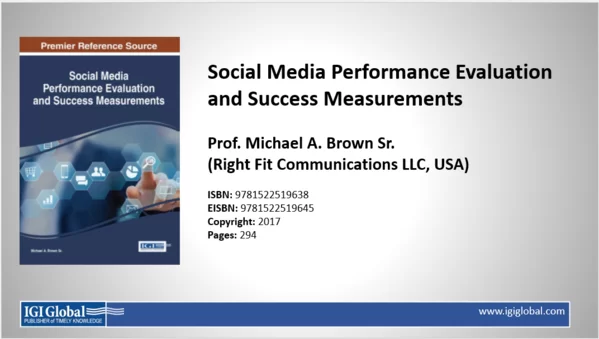
This work features some of my social communication research brought to publication thanks to IGI Global. You can purchase relevant chapters by selecting the link “Access This Chapter” at the bottom. Book Excerpt, Chapter 3, Page 47 This is an older work, but it is important to continue learning about and evaluating the use of digital communication. George Santayana said, “Those who cannot remember the past are condemned to repeat it.” That statement is the reason social communication is covered here with a historical view. This review of computer mediated communications (CMC) is helpful in understanding the nature of key developments. These led to the social media space we know today. Discussing the portable nature of various interactions is relevant as the foundation for a deep understanding of social communication. This is an important analysis in helping people understand the way we can use information technology to interact without the limitations of geographical distance and time. Access This Chapter!

Book Excerpt: Social Communication Research Read More »

solutions small

Book Excerpt: New Age Communications

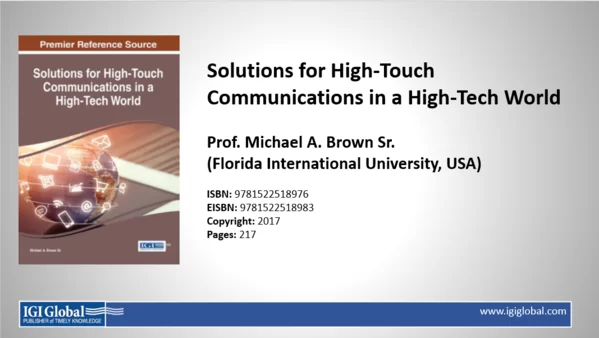
This time I\’m sharing about new age communications. You can purchase relevant chapters by selecting the link “Access This Chapter” at the bottom. Book Excerpt, Chapter 11, Page 210 Communication is about relationships and information sharing. When communicating, senders and receivers should agree on the purpose of the messaging activity and commit to an open and honest two-way exchange. Senders must try to understand the receiver’s information needs and attend to noise in the channel that includes emotions, relationships, and environment. Culture may also enter into the communication considerations. This can lead to the need to develop skills to handle diversity of thought and action between sender and receiver. Considering all the variables that can affect the interaction provides an ability to ensure that the message is suitable for the current social context. Access This Chapter!

Book Excerpt: New Age Communications Read More »

motivationally small

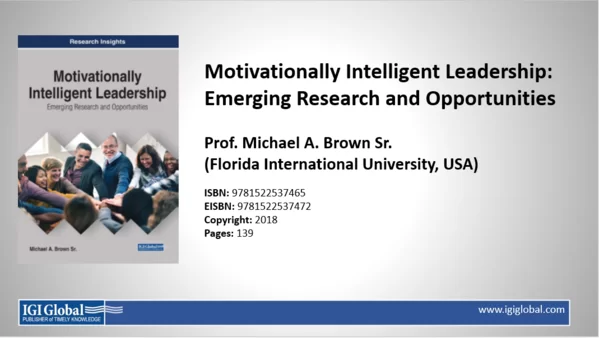
Book Excerpt: Motivationally Intelligent Leadership

This excerpt is from my work on motivationally intelligent leadership. You can purchase relevant chapters by selecting the link “Access This Chapter” at the bottom. Book Excerpt, Chapter 3, Page 34 The leader’s emotional intelligence can be viewed in terms of six leadership styles. They are coercive, authoritative, affiliative, democratic, pacesetting, and coaching (Goleman, Boyatzis et al., 2013, Girma, 2016). Leaders who can deal with disasters are coercive, and leaders who can engineer a turnaround are authoritative. Affiliative leaders can compromise to build team harmony and morale. Democratic leaders give their people a voice in decisions. Pacesetting leaders can define and exemplify high performance standards, and coaching leaders are supportive of the development of skills. No one style is best, because as leaders, master each of these styles, they gain additional power to shape employee performance and organizational climate (Girma, 2016). Mastery of these styles is what we call “leading.” SOURCE: The relationship between leadership style and employee job satisfaction study of federal and Addis Ababa sport organizational management setting in Ethiopia (Girma, 2016). Access This Chapter!


Book Excerpt: Motivationally Intelligent Leadership Read More »

news 13

RFL: Ideas for “Mature” Job Seekers

Some experts suggest more training or use of employment services when helping job seekers 50 and over. This approach is highlighted in an Urban Institute article in 2011, “Can Unemployed Older Workers Find Work?” The article\’s position may not, however, offer the best advice for those seeking an opportunity. One great initiative is offering networking services and increasing social media connections to assist in the job search. This is a welcome and necessary undertaking. There is a constant that can interfere with its effectiveness. If you connect with a person who has no job to offer, it is often just a conversation. The most effective connection, then, is when someone has a job to offer and is connected to someone is ready to accept that opportunity. That is the connection that is needed based on our current conversation. It is important to think about questions prospective employers may ask about older workers. How long will the person stay with us? What kind of time will the person spend with us before retiring? How will the person fit with younger workers? These are all valid questions, but they should not be disqualifying. More important, the questions should be posed equally, with minor changes, for younger job seekers. No one has all the answers to finding a job. This is food for thought and something employers may want to consider. If you are interested in the conversation, you can share your thoughts with me or take my survey.

RFL: Ideas for “Mature” Job Seekers Read More »

telework small

Book Excerpt: Relating to Emotional Intelligence (EI)

Emotional Intelligence (EI): Sharing another excerpt with you. You can purchase relevant chapters by selecting the link “Access This Chapter” at the bottom. Book Excerpt, Chapter 9, page 167 These findings are insightful because they help us examine the potential for leaders to improve communication in a variety of areas. These areas can include knowing your own strengths and weaknesses, being more capable of handling negative emotions, increasing your adaptability, finding ways to improve relationships, and communication skills. \”…the information presented here leads us to understand that adjusted or learned emotional intelligence skills can help people and organizations adopt strategies and policies that promote efficiency and that can enhance telework operations. Organizations have always tried to ensure the emotional skill of managers, but the vehicles have been employee selection, appraisal systems, and formal or informal feedback mechanisms. Improvements in managerial EI will not eliminate the need for those avenues of improvement; however, it can provide a mainstream way to transform and improve current practices and enhance existing knowledge.\” Access This Chapter!  You can get access to all of my works here.

Book Excerpt: Relating to Emotional Intelligence (EI) Read More »

0