Human Communication

solutions small

Book Excerpt: New Age Communications

This time I\’m sharing about new age communications. You can purchase relevant chapters by selecting the link “Access This Chapter” at the bottom. Book Excerpt, Chapter 11, Page 210 Communication is about relationships and information sharing. When communicating, senders and receivers should agree on the purpose of the messaging activity and commit to an open and honest two-way exchange. Senders must try to understand the receiver’s information needs and attend to noise in the channel that includes emotions, relationships, and environment. Culture may also enter into the communication considerations. This can lead to the need to develop skills to handle diversity of thought and action between sender and receiver. Considering all the variables that can affect the interaction provides an ability to ensure that the message is suitable for the current social context. Access This Chapter!

Book Excerpt: New Age Communications Read More »

productivity graphic e1658281591420

IABC Review: Leading Effectively With 3D, EI, Empathy

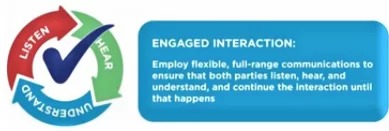
I spoke about leading and communicating at the International Association of Business Communicators (IABC) World Conference 2022 on June 27, 2022 in New York. The focus was engaged interaction and how communication creates strong relationships where leaders and members interact and achieve shared understanding. An interactive communication approach is one that leverages the skills and abilities of all team members. This approach also promotes a situation where everyone contributes. My formula for success is to take advantage of the benefits of a leader exchange theory. That means we are applying empathy to leadership communications, and using Emotional Intelligence (EI). I guide my efforts using my leadership focus, 3D, to be effective using these and other tools. The definition of 3D is Dedication, Detail, Discipline. This says we need to be dedicated so that we prepare, perform, and motivate every step of the way. It is important to pay attention to detail, creating shared understanding to enhance strengths and improve weaknesses. We must be disciplined, following rules to be the best we can always in all situations. Leaders should create strong relationships where they bond with and inspire members. The resulting improvements in the workplace can deliver increased personal and professional growth. Leaders also will deliver improved productivity and performance. This may also foster the creation of new ideas. We must compare performance and productivity. Performance focuses on output only, while productivity focuses on output in relation to input. I will continue to cover these areas with my colleagues. Please don’t hesitate to reach out if you’re interested in these topics.

IABC Review: Leading Effectively With 3D, EI, Empathy Read More »

right fit leading info series (1)

Right Fit Info Series: Teaching Plan Summaries Available

I have had a busy June talking to people about understanding and employing empathy and emotional intelligence (EI). I engaged with audiences about achieving shared understanding and building trust. The conversations and consultations have been so rewarding that I created four teaching plans that are readily available in my portfolio. I would be happy to discuss any of these plans with you. #emotionalintelligence #empathy #trust #iabc22 #iabc2022 #iabcwc Leadership Solutions in a Hybrid Workplace  1. Leaders in a hybrid workplace have special challenges that we can generalize as “distance.” Distance is a disconnected aspect that can occur in the work relationship at times that are important, such as when operations or personnel changes take place. It concerns accomplishments that are crucial to job satisfaction, recognition, promotion, and other factors that contribute to the quality of work life. Organizations need collective agreements that guide teams and foster shared understanding, collaboration, and innovation. This plan is based on the book 

Right Fit Info Series: Teaching Plan Summaries Available Read More »

worker 6

Right Fit Leading: Thoughts for Older Job Seekers and Employers

Some guidance for people 50 and over who are seeking employment centers around the need for more training and employment services. This approach has been well documented, including an Urban Institute article in 2011, “Can Unemployed Older Workers Find Work?” While this is necessary for many job seekers, there are just as many job seekers who need no training or employment services. They need an opportunity. There is another great initiative on the part of many people offering networking services and increased social media connections to assist in the job search. This is a welcome and necessary undertaking, but there is a constant that can interfere with its effectiveness. When the person that the prospective employee is connected to does not have a job to offer, it is often just a conversation. The most effective connection, then, is when someone has a job to offer and is connected to someone who will take it right away. That is the connection that is needed based on our current conversation. Without considering job seekers who are changing careers, there may also be questions that prospective employers ask themselves about older workers. How long will the person stay with us? How long is the person planning to continue working before retiring? How will the person fit with younger workers? These are all valid questions, but they should not be disqualifying. More important, the questions could be posed equally, with minor changes, for younger job seekers. No one has all the answers to finding a job, but I hope some of these issues are something to consider. I hope you will share your thoughts with me or take my survey.

Right Fit Leading: Thoughts for Older Job Seekers and Employers Read More »

56 (1)

Right Fit Leading: Hybrid Approach to Social Communication

My new article, \”Social Communication: Recommendations for a Hybrid Approach,\” is in the International Journal of Interactive Communication Systems and Technologies (IJICST) 8(1). ABSTRACT: Scholars continue to analyze the past, present and future of computer mediated communications (CMC) in an attempt to make sense of the pervasive social media environment in which people operate today. George Santayana said, “those who cannot remember the past are condemned to repeat it.” Social media grew, in part, out of a need to overcome communication limitations of geographical distance and time. in the process, human connection has suffered and some may even long for a way to close the geographic distance or approximate face-to-face interactions. this examination looks at hybrid approaches to social communication. You can access the article here.

Right Fit Leading: Hybrid Approach to Social Communication Read More »

2011 09 23 07.44.34 (1)

Right Fit Leading: Motivation is Choice, Effort, Persistence

Choice refers to either getting people to select an action on their own or making a case for why they should take the path the leader or the group recommends.  Effort is about how much energy a person gives to an initiative.  Persistence is when people keep trying even if they don’t believe their effort and energy is enough.  This is ultimately about faith.  A motivational leader can inspire the kind of adrenaline in a person that allows them to move past their hesitations, find energy where there is none, and believe even if they don’t have all the reasons for that belief.   Leader communications should reinforce these concepts to motivate people.   Get Published: If you have some great ideas about leadership communication and its importance, check out the call for chapters for a new book, Returning to Interpersonal Dialogue and Understanding Human Communication in the Digital Age.  It\’s not too late to submit a chapter, or get more information, here: Returning to Interpersonal Dialogue.

Right Fit Leading: Motivation is Choice, Effort, Persistence Read More »

Submission Deadline Extended: Interpersonal Dialogue Call for Chapter Proposals

We have extended the deadline to submit chapters to May 1.  You still have a chance to join the project! Returning to Interpersonal Dialogue and Understanding Human Communication in the Digital Age A book edited by Michael A. Brown Sr, PhD, Florida International University, and Leigh Hersey, Ph.D., University of Louisiana at Monroe   Introduction Human communication is struggling in what is a global crisis.  Society no longer fosters face-to-face interactions.  Compounded by the influence of the digital world, digitally-driven interactions in a multi-generation society have resulted in personal interactions that are fraught with limited feedback, erroneous and incomplete information leading to misunderstandings, even confrontations.  Digital collaborations are abundant, but can be problematic as an incomplete solution to the human need for comprehensive communication.  The 5,000 digital messages the average American receives daily lack full-process interactions from sender to receiver to feedback (see note). This creates communication based on missing information, gaps in communication, misinterpretation of language and other barriers.  Human communication distinguishes face-to-face communication as a priority over online or digital interactions.  This is not to downplay the electronic arena; just to highlight the connection between people that involves the five senses.   Objective of the Book Dr. Brown’s previous work in Solutions for High-Touch Communication in a High-Tech World (IGI Global, March 2017) sets the stage for a full examination of human communication in today’s society by comparing online and face-to-face interactions.  This book takes advantage of that foundation and develops solutions for success in academia and in business by analyzing various types of face-to-face and digital interactions in terms of comprehension and relationship-building.  The integration of techniques for all human communication gives people resources to be successful collaborators in contemporary society.  This is an approach you won’t find in any one book today.   Submission Procedure Researchers and practitioners are invited to submit on or before May 1, 2017, a chapter proposal of 1,000 to 2,000 words clearly explaining the mission and concerns of his or her proposed chapter. Submit your proposal at http://www.igi-global.com/publish/call-for-papers/call-details/2660.  

Submission Deadline Extended: Interpersonal Dialogue Call for Chapter Proposals Read More »

Right Fit Leading: Leadership Ingredients Defined

  Leadership is analysis without bias, momentum without fatigue, and action without discouragement.   Analysis without Bias: Skill is important because leaders have to know what they are doing.  They analyze the way ahead and determine what is necessary.  You can determine what is necessary by yourself or with the team, but you have to make the determination.  When you analyze the situation or the task at hand, you have to begin without caring what the final answer will be, and you have to keep an open mind throughout the analysis.  If you do this without preconceived notions, especially with a group, you can find new ideas and different viewpoints that will be beneficial.   Momentum without Fatigue: Once you decide which way to go, get going.  Attack the solution with conviction and create that momentum that will propel you and the team to the project’s successful conclusion.  There will be challenges and disappointments along the way, but great leaders don’t get tired.  They keep pushing toward the decided course of action.  This is important to the relationship with the team.  Members of the team may tire, but they can feed off the leader’s energy.  If the leader truly becomes tired, it is time for a team champion to take the lead temporarily.  This will signal that the leader’s trust in the team that has been assembled.  But the leader can’t stay disconnected for long, because there is still much to do.   Action without Discouragement: Once the leader has a decision on a course of action, it’s time to move out.  Always take action to implement the decisions that have been made based on the analysis of the goal and its needs.  There will be bumps in the road, but effective leaders don’t get discouraged.  They commit to the decided course of action and move in that direction.  They show the team that all of the prior work was necessary and that the results are accurate.  If there is a problem, a course correction is always the preferred way to proceed instead of starting from scratch.  If the leader finds it necessary to start from scratch, it is important to not only explain it to the team, but to fully go back and find out where the analysis may have gone wrong.   Get Published: By the way, communication is essential for leaders.  If you have some great ideas, check out the call for chapters for a new book, Returning to Interpersonal Dialogue and Understanding Human Communication in the Digital Age.  Submit a chapter, or get more information, here: Returning to Interpersonal Dialogue.

Right Fit Leading: Leadership Ingredients Defined Read More »

0