
IGI Global

about (1)

RFL: Interactive Communications

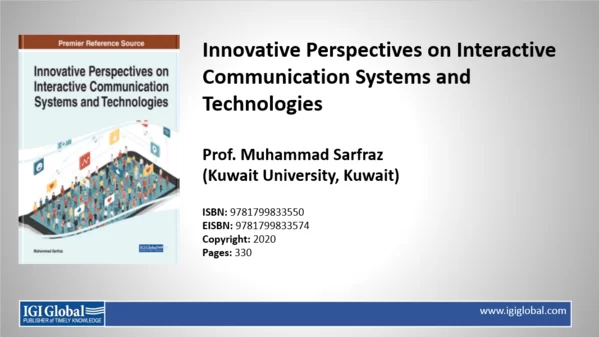
Recently, I have been talking with colleagues about a book chapter I wrote on interactive communications, which combines the best of digital and face-to-face communication. This is about hybrid approaches to communication and what I find out in my research. First, digital communication is the best method. Second, these communications improve when combined with face-to-face interactions. Hybrid communicating involves asking detailed questions and verifying answers in the digital space. If that does not work, face-to-face interactions provides verbal and visual cues. This allows all parties to the communication to adjust based on real-time inputs. My research in this area demonstrates that interactive communication skills are one of many kinds of tools that can assist with leader and team development. The book in question is Innovative Perspectives on Interactive Communication Systems and Technologies by Muhammad Sarfraz, and my contribution is chapter 11. I look forward to continuing discoveries in this area. Note: RFL is Right Fit Leading, our approach to the leader and member development journey.

RFL: Interactive Communications Read More »

about (1)

Right Fit Leading: Telework Has a Bad Reputation

Telework has a bad reputation. This can be caused when employers and employees fail to understand it. Companies may fail to see the ability for the employee to be as productive whether in the the office or working remotely. Remote employees may fail to be accountable for 8 or so productive hours of tangible work each day. The company may not have a process to address these issues. Or, the company may lack a process that is clear and easy to follow. Following standards and being accountable are difficult in these situations. Open, honest discussions about trust and work location are keys to success.

Right Fit Leading: Telework Has a Bad Reputation Read More »

innovative small

Book Excerpt: Hybrid Communication and Learning Approaches

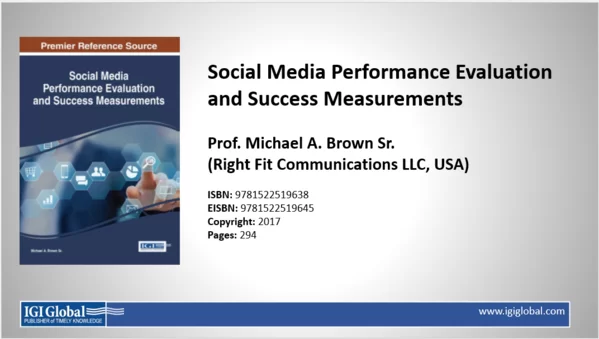
I am sharing excerpts from some of my works, including this one concerning hybrid communication and learning approaches. You can purchase relevant chapters by selecting the link “Access This Chapter” at the bottom. Book Excerpt, Chapter 11, Page 226 Today’s scholars discuss the importance of taking a hybrid approach to social communication. This hybrid effect combines the best of face-to-face and online choices. The approach also considers various influences on communications. My research in this area suggests an approach that combines the best of face-to-face and online communication. Also, some researchers suggest that even when online is the better method, it was more effective when combined with face-to-face interactions (M. A. Brown, 2017, p. 209). Everyone strives for the best possible message-medium fit tailored to the choice of media and type of use. This type of correct \”fit\” results in enhanced collaborations. Once you achieve that fit, you can focus on message, media-mix, task, online success, interaction partners, and other best practices (Bubaš, 2001). This work addresses the continued growth of the online space. This growth allows us to work toward a hybrid approach to combining face-to-face and online activities. The approach allows us to move to a discussion of the importance of trust in effective collaborations. We build trust, in part, by overcoming and adjusting to communication barriers. Building trust this way often leads to discussions about communication success and suggests the proposed hybrid approach. Access This Chapter!

Book Excerpt: Hybrid Communication and Learning Approaches Read More »

social small

Book Excerpt: Social Communication Research

This work features some of my social communication research brought to publication thanks to IGI Global. You can purchase relevant chapters by selecting the link “Access This Chapter” at the bottom. Book Excerpt, Chapter 3, Page 47 This is an older work, but it is important to continue learning about and evaluating the use of digital communication. George Santayana said, “Those who cannot remember the past are condemned to repeat it.” That statement is the reason social communication is covered here with a historical view. This review of computer mediated communications (CMC) is helpful in understanding the nature of key developments. These led to the social media space we know today. Discussing the portable nature of various interactions is relevant as the foundation for a deep understanding of social communication. This is an important analysis in helping people understand the way we can use information technology to interact without the limitations of geographical distance and time. Access This Chapter!

Book Excerpt: Social Communication Research Read More »

solutions small

Book Excerpt: New Age Communications

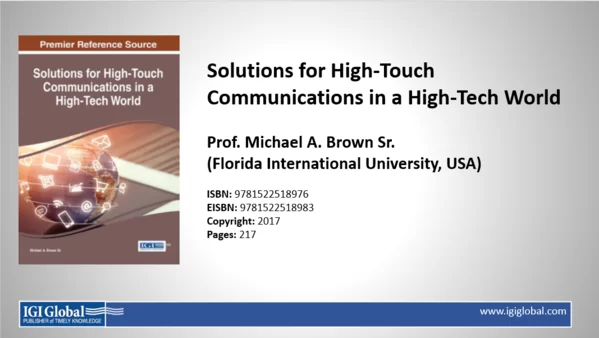
This time I\’m sharing about new age communications. You can purchase relevant chapters by selecting the link “Access This Chapter” at the bottom. Book Excerpt, Chapter 11, Page 210 Communication is about relationships and information sharing. When communicating, senders and receivers should agree on the purpose of the messaging activity and commit to an open and honest two-way exchange. Senders must try to understand the receiver’s information needs and attend to noise in the channel that includes emotions, relationships, and environment. Culture may also enter into the communication considerations. This can lead to the need to develop skills to handle diversity of thought and action between sender and receiver. Considering all the variables that can affect the interaction provides an ability to ensure that the message is suitable for the current social context. Access This Chapter!

Book Excerpt: New Age Communications Read More »

motivationally small

Book Excerpt: Motivationally Intelligent Leadership

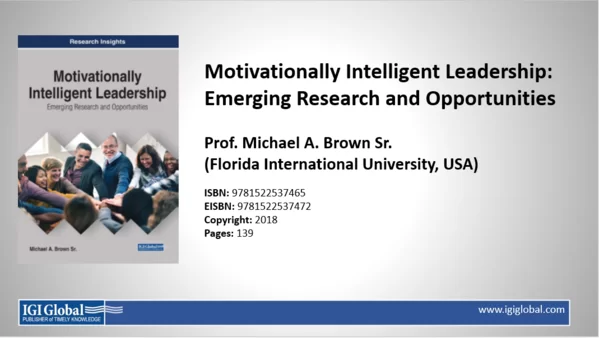
This excerpt is from my work on motivationally intelligent leadership. You can purchase relevant chapters by selecting the link “Access This Chapter” at the bottom. Book Excerpt, Chapter 3, Page 34 The leader’s emotional intelligence can be viewed in terms of six leadership styles. They are coercive, authoritative, affiliative, democratic, pacesetting, and coaching (Goleman, Boyatzis et al., 2013, Girma, 2016). Leaders who can deal with disasters are coercive, and leaders who can engineer a turnaround are authoritative. Affiliative leaders can compromise to build team harmony and morale. Democratic leaders give their people a voice in decisions. Pacesetting leaders can define and exemplify high performance standards, and coaching leaders are supportive of the development of skills. No one style is best, because as leaders, master each of these styles, they gain additional power to shape employee performance and organizational climate (Girma, 2016). Mastery of these styles is what we call “leading.” SOURCE: The relationship between leadership style and employee job satisfaction study of federal and Addis Ababa sport organizational management setting in Ethiopia (Girma, 2016). Access This Chapter!

Book Excerpt: Motivationally Intelligent Leadership Read More »

telework small

Book Excerpt: Relating to Emotional Intelligence (EI)

Emotional Intelligence (EI): Sharing another excerpt with you. You can purchase relevant chapters by selecting the link “Access This Chapter” at the bottom. Book Excerpt, Chapter 9, page 167 These findings are insightful because they help us examine the potential for leaders to improve communication in a variety of areas. These areas can include knowing your own strengths and weaknesses, being more capable of handling negative emotions, increasing your adaptability, finding ways to improve relationships, and communication skills. \”…the information presented here leads us to understand that adjusted or learned emotional intelligence skills can help people and organizations adopt strategies and policies that promote efficiency and that can enhance telework operations. Organizations have always tried to ensure the emotional skill of managers, but the vehicles have been employee selection, appraisal systems, and formal or informal feedback mechanisms. Improvements in managerial EI will not eliminate the need for those avenues of improvement; however, it can provide a mainstream way to transform and improve current practices and enhance existing knowledge.\” Access This Chapter!  You can get access to all of my works here.

Book Excerpt: Relating to Emotional Intelligence (EI) Read More »

magnifying glass guy

Seeking Journal Reviewers

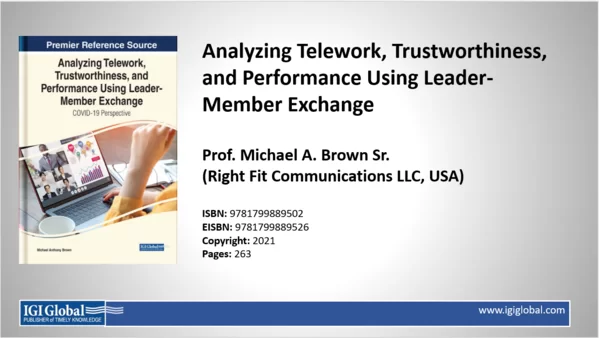
In addition to continuing the research for my latest IGI Global book on telework, I am seeking reviewers for the International Journal of Responsible Leadership and Ethical Decision Making (IJRLEDM). I am the interim editor-in-chief. IJRLEDM focuses on the role of science to help improve leadership within business and to include traditional and emerging future leadership roles. It also emphasizes responsibilities, cognition, leadership decision-making, ethics, and research methods supporting qualitative and quantitative study of these areas of life, business, and academics. Ad hoc reviewers should be able to review a minimum of 2 or 3 articles per year. If you are interested in joining this effort as an ad hoc reviewer, please apply at

Seeking Journal Reviewers Read More »

citizen small

Book Excerpt: Predictors of social networking

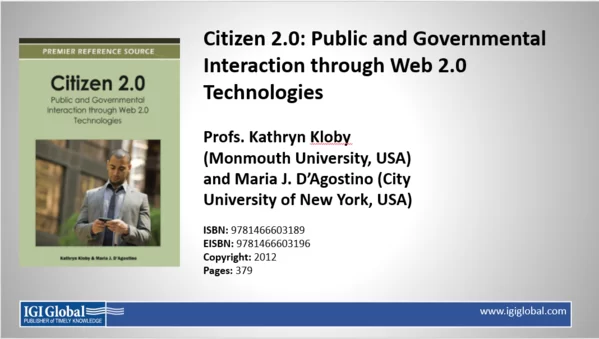
Predictors: I am sharing excerpts from some of my works. You can purchase relevant chapters by selecting the link “Access This Chapter” at the bottom. Chapter 8, Predictors of Social Networking and Individual Performance, Michael A. Brown (Old Dominion University, USA) and Mohamad Alkadry (Florida International University, USA) Book Excerpt, Chapter 8, Page 129 Public organizations that can successfully predict participation and understand the value propositions that drive performance can be very effective in social networking, which is a process and practice by which people and organizations are drawn together by family, work, or hobby to interact via websites. This chapter examines the relationship between social networking and individual performance. It also suggests a social networking participation model that takes advantage of innovation adoption and other important theories to help public organizations understand acceptance or rejection of participation. In a recent study, responses from 191 public administrators were analyzed using structural equation modeling (SEM) to focus on the relationship between participation and five constructs: perceived usefulness, perceived ease of use, perceived improvement potential (PIP), intra-organizational trust, and type of use. The study demonstrates favorable model fit statistics that support positive correlations between the latent variables examined and the dependent variable, participation. The results demonstrate the potential of the survey instrument to serve as an adoption and participation methodology that can provide public organizations with knowledge that predicts and promotes social networking activities as they relate to perceived performance improvement. This approach arms organizations and leaders with a new lens with which to focus on the value proposition regarding perceived improvement potential based on social networking participation. Access To This Chapter! You can get access to all of my works here.

Book Excerpt: Predictors of social networking Read More »

0