
Telework

about (1)

Right Fit Leading: Telework Has a Bad Reputation

Telework has a bad reputation. This can be caused when employers and employees fail to understand it. Companies may fail to see the ability for the employee to be as productive whether in the the office or working remotely. Remote employees may fail to be accountable for 8 or so productive hours of tangible work each day. The company may not have a process to address these issues. Or, the company may lack a process that is clear and easy to follow. Following standards and being accountable are difficult in these situations. Open, honest discussions about trust and work location are keys to success.

Right Fit Leading: Telework Has a Bad Reputation Read More »
telework small

Book Excerpt: Relating to Emotional Intelligence (EI)

Emotional Intelligence (EI): Sharing another excerpt with you. You can purchase relevant chapters by selecting the link “Access This Chapter” at the bottom. Book Excerpt, Chapter 9, page 167 These findings are insightful because they help us examine the potential for leaders to improve communication in a variety of areas. These areas can include knowing your own strengths and weaknesses, being more capable of handling negative emotions, increasing your adaptability, finding ways to improve relationships, and communication skills. \”…the information presented here leads us to understand that adjusted or learned emotional intelligence skills can help people and organizations adopt strategies and policies that promote efficiency and that can enhance telework operations. Organizations have always tried to ensure the emotional skill of managers, but the vehicles have been employee selection, appraisal systems, and formal or informal feedback mechanisms. Improvements in managerial EI will not eliminate the need for those avenues of improvement; however, it can provide a mainstream way to transform and improve current practices and enhance existing knowledge.\” Access This Chapter!  You can get access to all of my works here.

Book Excerpt: Relating to Emotional Intelligence (EI) Read More »

right fit leading info series small (1)

Examining Remote Work Pros and Cons

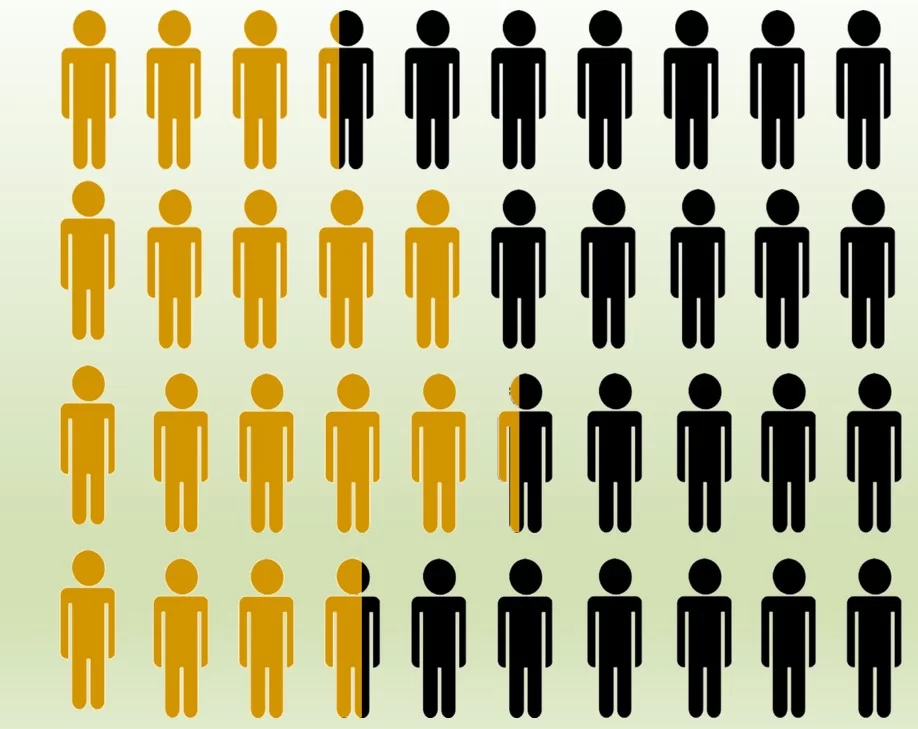
While I was doing research on remote work for my latest book, Analyzing Telework, Trustworthiness, and Performance Using Leader-Member Exchange: COVID-19 Perspective, I found consistent themes in terms of reluctance to allow telework/remote work. I characterized the research into 13 reasons that may be given about the perils of telework/remote work. Let me provide some detail on three examples that relate across some of the reasons in this list. EXAMPLE 1: One manager told me, “I need to have impromptu meetings to work out problems or to address emerging issues.” These were my questions. EXAMPLE 2: One leader told me, “I need face-to-face connection with workers who need structure or close supervision.” These were my questions. EXAMPLE 3: The director in one organization told me she was just more comfortable with employees onsite and that there were rewards or incentives available, making it unnecessary to offer remote work as an incentive. I asked her to think about an employee she could not do without. Then I asked questions. I cannot answer these questions for anyone. There are many variables and situations that must be considered to determine one of four paths in this area: Leaders should be at least open to considering the use of some form remote work. This helps prepare organizations to successfully transition to distributed operations during times of emergency and, just as important, enables ways to enrich the work environment for the workforce. Considering the use of remote work or some hybrid approach opens the door to win-win situations for both organization and employee. We never know what will happen tomorrow but, as COVID taught us, having a way for people to take care of their loved ones while still working is important. This is important as demonstrated in a survey that reported that 37% of employees would leave their current job in favor of one that allowed them to choose their work location at least part of the time (Gallup, 2017). I recommend thinking of telework as an investment in people to give them flexibility in the interest of improving work-life balance. Using a hybrid approach can be effective if you ensure two-way communication with feedback to create and nurture trust. It should be combined with culture and operations supportive of both on site and remote workers promoting equal treatment in an effort to achieve buy-in. REFERENCE: Gallup, I. (2017). State of the American workplace. Pobrane z http://www. gallup. com/reports/199961/state-american-workplace-report-2017. aspx.

Examining Remote Work Pros and Cons Read More »

right fit leading info series (1)

Right Fit Info Series: Teaching Plan Summaries Available

I have had a busy June talking to people about understanding and employing empathy and emotional intelligence (EI). I engaged with audiences about achieving shared understanding and building trust. The conversations and consultations have been so rewarding that I created four teaching plans that are readily available in my portfolio. I would be happy to discuss any of these plans with you. #emotionalintelligence #empathy #trust #iabc22 #iabc2022 #iabcwc Leadership Solutions in a Hybrid Workplace  1. Leaders in a hybrid workplace have special challenges that we can generalize as “distance.” Distance is a disconnected aspect that can occur in the work relationship at times that are important, such as when operations or personnel changes take place. It concerns accomplishments that are crucial to job satisfaction, recognition, promotion, and other factors that contribute to the quality of work life. Organizations need collective agreements that guide teams and foster shared understanding, collaboration, and innovation. This plan is based on the book 

Right Fit Info Series: Teaching Plan Summaries Available Read More »

telework survey group representation

Right Fit Leading: Telework vs Personal Choice

When I see leaders dealing with the choice to let their workforce work onsite or remotely, I often hear discussions about past practices and the need to have close contact. Those are important considerations, but the more important conversation is what employees want from their position and work life. The world has shown everyone remote ways to do the job, and the discussion should be about how to take advantage of the knowledge. The key is that people are finding they have a choice, and the decision to leave may be easier than ever. All most people want is a say in where they work so that they can adjust their work to their life instead of the other way around. If leaders cannot find a way to accommodate them, they may continue to see people leave. View Dr. Brown’s video here.

Right Fit Leading: Telework vs Personal Choice Read More »

analyzing telework book e1666299180827

Right Fit Leading: Telework Benefits

Companies are trying to determine what “back to work” should look like, and workers are trying to take advantage of the positive work life changes they found in COVID-19. As the workplace changes, we must pay attention to trustworthiness and performance as they relate to telework. Trustworthiness is the quality of a person that inspires reliability. When it exists, behaviors like being respectful, honest, consistent, positive, and selfless will be evident. Managers who follow telework policies developed in response to COVID-19, or developed for other reasons, are building trust. Trust can then grow as emotions are shared and real issues are addressed professionally. View Dr. Brown’s video here.

Right Fit Leading: Telework Benefits Read More »

telework article art

New Journal Article on Telework, Trust, Performance

Thanks to IGI Global for publishing the paper \”Examining the Influence of COVID-19 on Telework, Trustworthiness, and Performance\” that I wrote with David Miller. I appreciate the continued support of my research and writing!  https://www.igi-global.com/article/examining-the-influence-of-covid-19-on-telework-trustworthiness-and-performance/297086

New Journal Article on Telework, Trust, Performance Read More »

analyzing telework book e1666299180827 (2)

Right Fit Leading: The Beauty of a Network

Thanks to Jim Goodwin, Leslie Krohn, and Denise Siegfeldt for helping me make my latest book a reality well ahead of my publisher’s deadline. As I look at my author’s copy, I realize it would not be in my hands now if you had not worked with me. I also must thank the 13 great friends who indulged me in qualitative interviews to share their thoughts on COVID and telework. Analyzing Telework, Trustworthiness, and Performance Using Leader-Member Exchange: COVID-19 Perspective. The book focuses on evaluating the response to the pandemic and on how to continually improve teleworking and organizations in their utilization of remote work. This book provides multifaceted perspectives focused on all parties involved in these issues, covering topics such as employee risk, telework resistance, and performance. I am anxious to share my research or to engage in research with people and organizations concerning these compelling issues and concepts.

Right Fit Leading: The Beauty of a Network Read More »

analyzing telework book e1666299180827 (1)

Analyzing Telework, Trustworthiness, and Performance Using Leader-Member Exchange

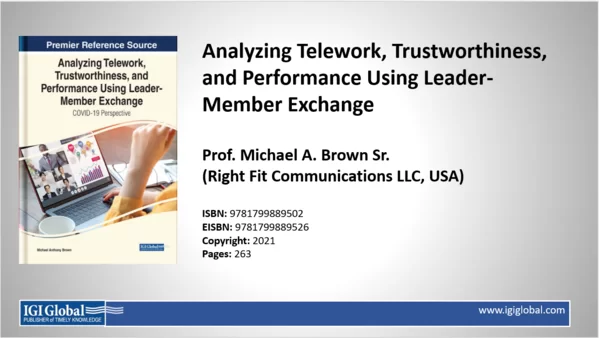
Happy that IGI Global moved up the publication date of my new book from January 2022 to October 2021. Analyzing Telework, Trustworthiness, and Performance Using Leader–Member Exchange takes a COVID perspective to address an understanding of and solutions to teleworking, trustworthiness, and performance issues. Overall, it suggests using a strategic approach that encourages participation and that is required to achieve, understand, and build buy-in for teleworking. The organizationally sanctioned program must exist. The use of LMX is beneficial in exploring the factors that contribute to motivating the target audience: employees. A culture of self-motivation is necessary to empower employees, but there must also be a culture of enforcement when needed. Finally, buy-in at all levels of the organization is crucial to the success of a telework program. The parts of the strategic approach mentioned here will be enhanced with the resources provided in this book: how to develop leaders, motivating employees, increasing productivity, using EI, managing radical change, and learning from the research provided. Viewed through the lens of a management context, these components make the recommended strategic approach possible and can deliver an effective framework for results.

Analyzing Telework, Trustworthiness, and Performance Using Leader-Member Exchange Read More »

0